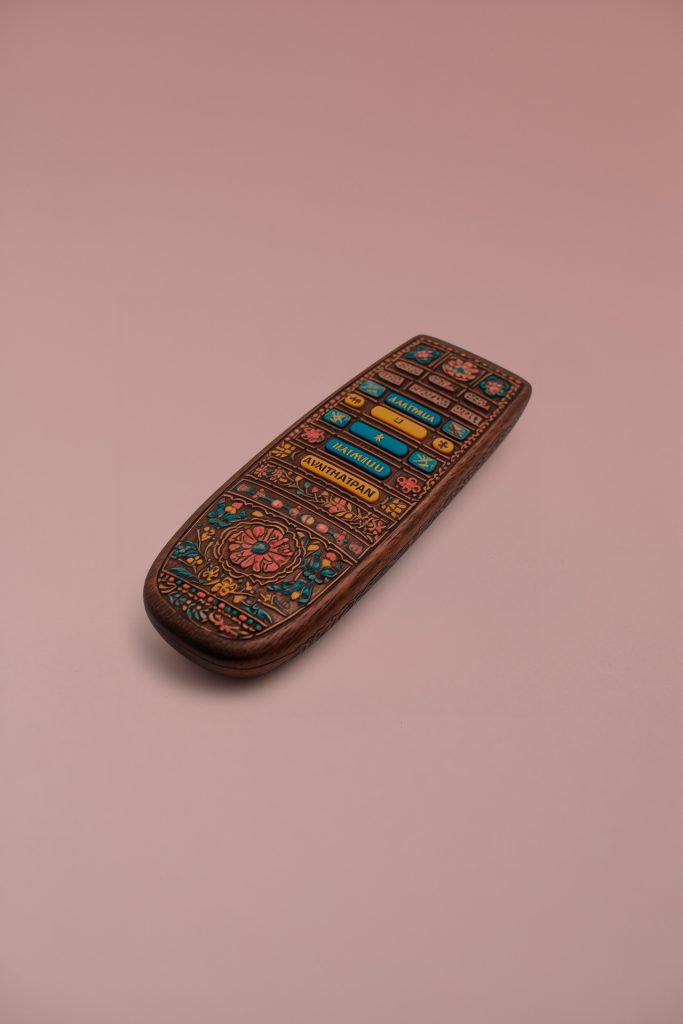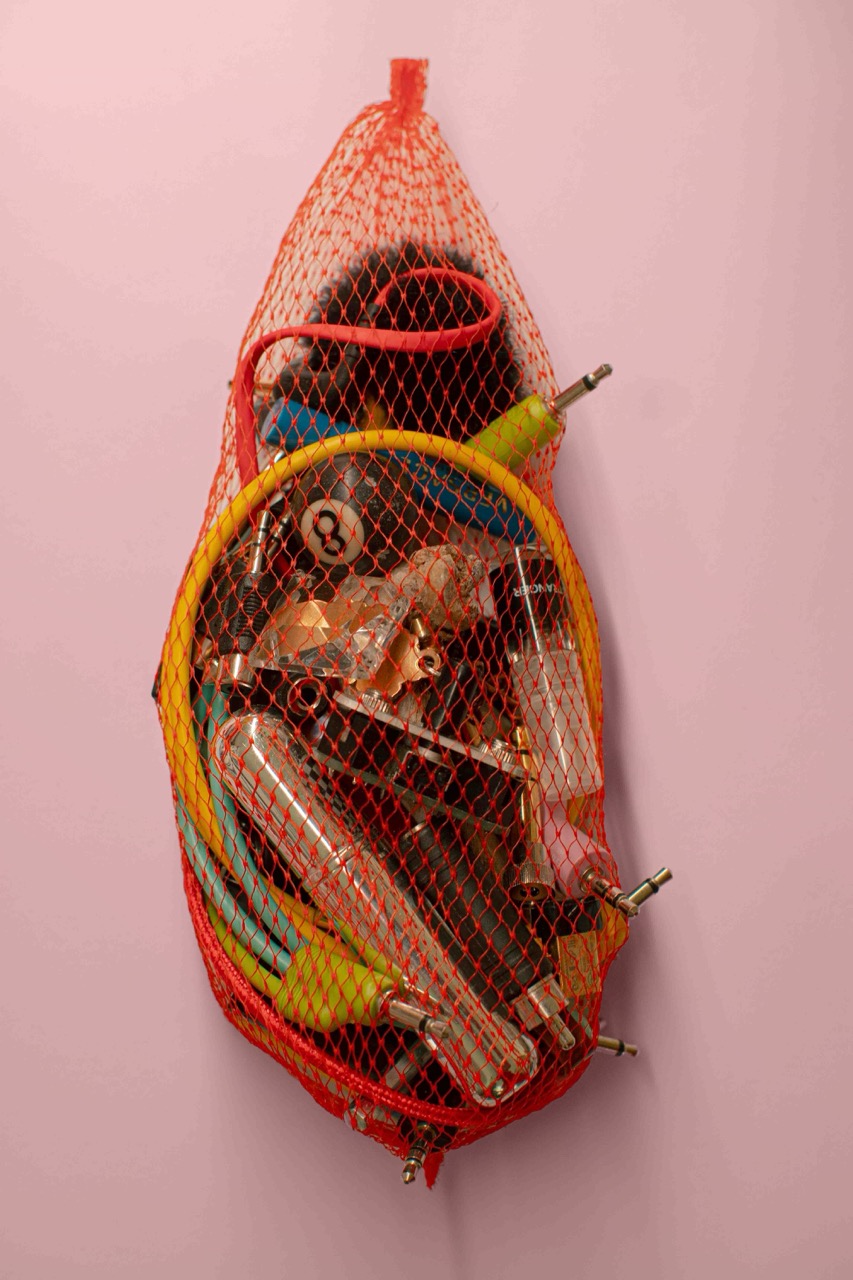
Sonic archeology brush
Dig It Up and Cut It. Following the Trails of the Shukai and Muscut Labels
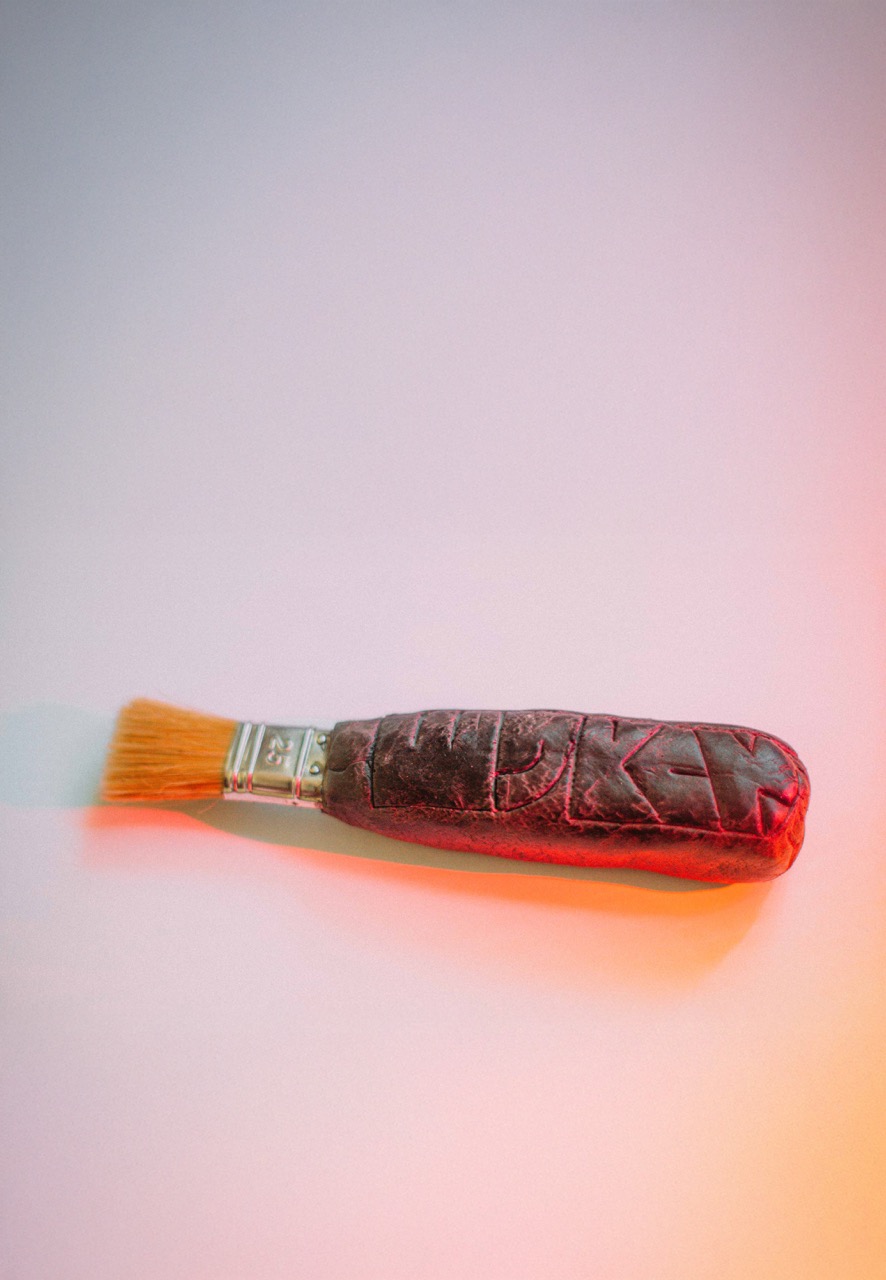
Muscut’s profile photo says more than all the interviews and reviews put together. Here, a man photographed from behind is holding a cassette tape, dug straight out of the ground. He is wearing a light-coloured shirt and a wide-brimmed hat, like an archaeologist at a field excavation, and in his hand – a small brush for cleaning the tape. A musical Indiana Jones operating on the fringes of phonography. This time, however, it is not about colonial plunder, but about discovering his own Ukrainian heritage.
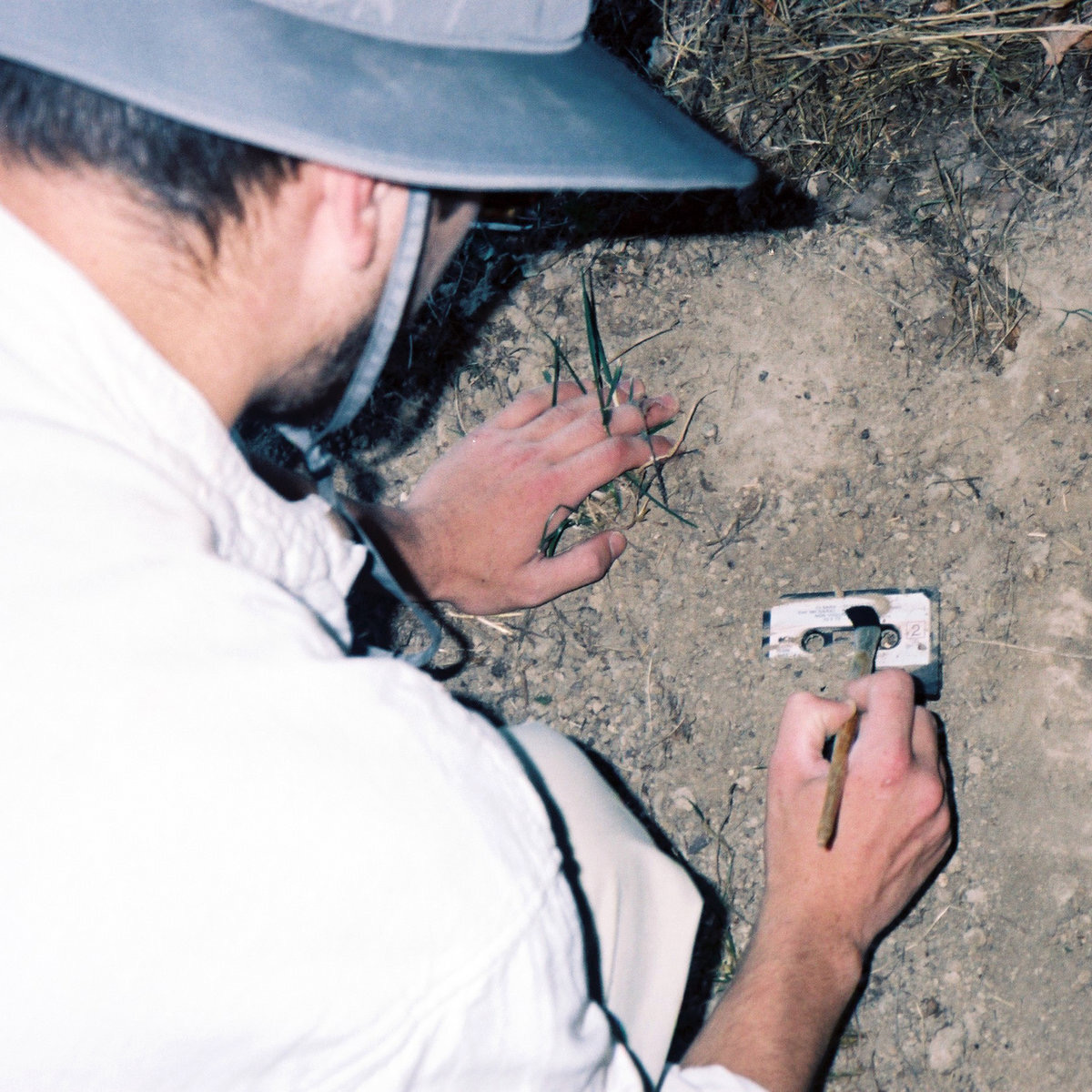
According to the motto often repeated by Dmytro Nikolaienko, these are two facets of the same curatorial strategy. “Muscut is pseudo-archaeology, whilst Shukai is a practical branch of sound archaeology” 1 He founded his first label in 2012 and his second in 2019 – together with Aleksandr Capenko and Dmitry Prutkin. Both have significant names: Muscut refers to the syllabic poetry typical of the Soviet avant-garde (so it would be about music and cutting); Shukai is a common noun, but it is also… the surname of the bassist in the band Can (so it would refer to retro mania). Viktoria Yakobchuk quotes Capenka and Prutkin on the Amnesia website:
Shukai is a name with a double meaning. Firstly, we are all fans of Holger Shukai’s work. Secondly, it is a beautiful Ukrainian word meaning ‘digger’. And our work is, in fact, a process of constant exploration. (…) You cannot visit any Ukrainian library and spend the whole day listening to recordings in a hypothetical section entitled ‘Film music of the second half of the 20th century’, because they simply do not exist. Of the state archives, only the G.S. Pshenychny Central State Film, Photo and Phonographic Archive of Ukraine stores information in a suitable manner. Nevertheless, it is extremely difficult to find recordings there worth releasing – only academic and classical music, favoured by the Soviet state apparatus, interviews with cosmonauts and combine harvester operators, etc., have survived. Shukai, however, is looking for ‘different’ music 2
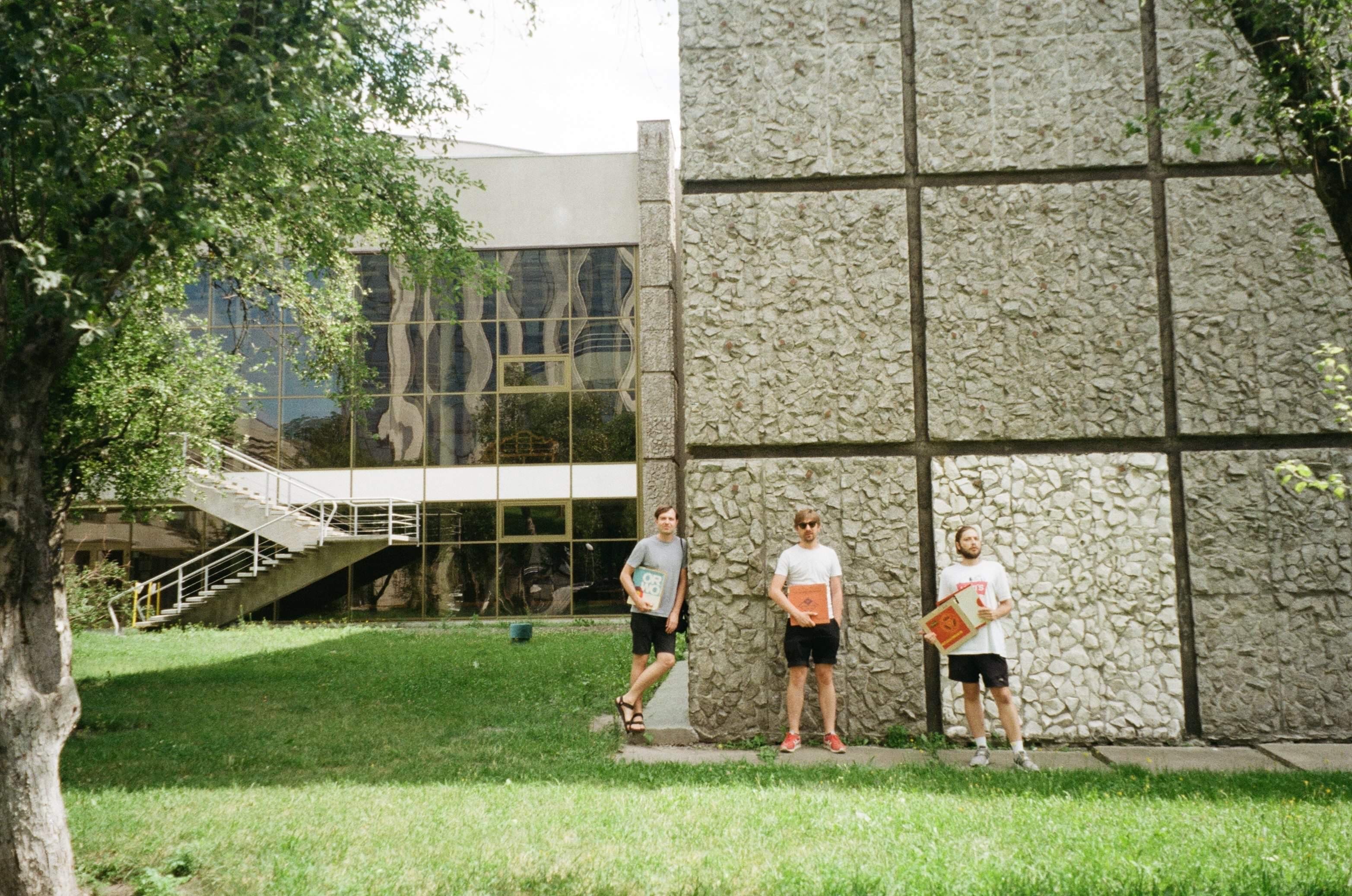
What kind of music, exactly? In one interview, Nikolaienko lists its key characteristics. The music on Shukai should: 1) be previously unreleased; 2) have been created between 1960 and 1991; 3) be “strange, unconventional, avant-garde and connected to Ukraine” 3. We will explore these three principles using the example of the nine vinyl records released to date. Among them, one can identify at least two recurring themes: forgotten soundtracks (Vladimir Vlasov, Volodymyr Bystriakov) and the pioneers of spiritual ambient (Valentyna Goncharova and Svitlana Nianio). They are also united by a consistent layout, reminiscent of Japanese sleeves with a white strip containing all the information and collages of period photographs – it helps that Prutkin and Nikolaienko are graphic designers.
Air, mirror, toys
Shukai launched with an album featuring Vladimir Vlasov’s score for The Air Merchant (1967). Vladimir Ryabtsev’s television film is an adaptation of a novel by the cult early 20th-century author Alexander Belyaev (known as the ‘Soviet Verne’ 4. This is another science fiction production from the Odessa Art Film Studio following Forward to Dreams (1963). In keeping with communist logic, a kidnapped Soviet engineer saves the world here by thwarting the capitalist plot of an American businessman. The titular merchant extracts oxygen from the Earth’s atmosphere, only to compress it and sell it on the market in capsule form. “Tragedies! Catastrophes!” – the film begins with the cries of newspaper sellers in English and Russian (which the album happens to end with, as it follows its own musical logic).
By the 1960s, Vlasov was already an established composer, albeit mainly of accordion music; it was only later that he became involved with film and electronic music (the band Zodiak). In an interview accompanying the album’s release 5 he explains that the producers of The Air Merchant wanted fantastical sounds. For want of better options (he only had a primitive East German Junost synthesiser at his disposal), Vlasov suggested jazz – drawing inspiration from the New Wave cinema of Poland and Czechoslovakia. Indeed, The Air Seller (2019)features plenty of swing (accompanying various parties), whilst the groove – with its pizzicato double bass, organ sounds and lively percussion – also catches the ear (the stealth and escape scenes, Nikola Is Sneaking). The opening scenes also feature trumpet solos and dissonant motifs (the chase across the coastal rocks, Climbing up the Hill).
In the laboratory sequences, Vlasov ingeniously coaxed high-pitched tones from the synthesiser that sound like electronic pulses emanating from machinery (Attention! Prepare for the Experiment). The result is an almost industrial soundscape of crackles, screeches and whistles; when attempting to compress oxygen, chirping pulsations appear, and as the temperature rises, ascending noises follow. In the 21st century, the author made no secret of his surprise that three young people wanted to release music from 60 years ago, and even suspected some sort of scam. Meanwhile, thanks to this new approach, the song Why? was brought to the fore; in the film, it had been replaced by another track – much to the emotion of Vlasov, hearing the piece for the first time in over half a century.
The release of The Air Seller became a founding legend for Shukai. As Capenko recounted in an interview with the website Amnesia 6, he found the label’s archives in a state of utter disarray. Several years after the death of the chief custodian, the tape canisters were covered in mould, and hard drives were strewn across the floor. During the digitisation attempt, equipment that had not been used for a long time damaged the film, so the Shukai team transported the materials from Odessa to Kyiv. In numerous interviews, the label’s founders reveal a sense of mission – “who else but us?”. They draw attention to similar initiatives, mainly in the field of architecture (1000 Doors of Odessa (Doors of Odesa: Restoration and reproduction of antique doors & windows, 1000doors.org/en.), Podilpostmodern, #savekyivmodernism). In the field of music, Shukai has virtually no competition in the East: Prutkin mentions Frotee (Estonia) and the GOST Archive (Russia); Nikolaienko, in turn, draws attention to the Funked Up East channel (Funked Up East, www.youtube.com/@mishapanfilov).
It is telling that older composers often react with suspicion to attempts to release archival material and prefer to offer more recent work – yet this lacks the freshness and appeal of the material from decades ago. Take, for example, two soundtracks by Volodymyr Bystriakov for animated films: Alice Through the Looking Glass (1981) and Battlefield (1986). The first 7, directed by Yefrem Pruzhansky, was a cult television adaptation in the late Soviet Union; the second is a short film by Mikhail Titov, based on a story by Stephen King. In both, Bystriakov, though experienced in animation and television, plays with synthesizers as joyfully as a child.
The theme for Alice is somewhat reminiscent of the modern opening theme for the Clannad TV series 8 , whilst the ‘Garden Creatures’ motif, in turn, recalls the later style of Małe Instrumenty. There are stylisations of old dances with harpsichord ornamentation (Black Queen), but also guitar references to country music (Mirrored Book Reading) or unsettling repetitions and contrasts (Behind the Looking-Glass). All in all, Alice through the Looking-Glass (2019) is better listened to than watched today – which might provide food for thought for some sort of ‘spiritual’ theory as to why music from the 1980s ages better than film. Bystriakow displays humour and inventiveness here, but he is also capable of creating a lyrical effect, as in the song with harp accompaniment (untitled 2). Synthesised instrument simulations, combined with live percussion and onomatopoeic effects, make for truly surreal music.
Battlefield (2022) is a different aesthetic, evident too in the visuals, styled as a noir crime thriller. The plot centres on a professional hitman who is hired to kill the inventor of smart toy soldiers. After completing the job, he cannot resist the temptation to steal a briefcase containing the victim’s inventions, and back at home, these inventions organise themselves into a real army and exact their revenge. The conflict escalates all the way to a pocket-sized nuclear weapon (the animation premieres in the year of the Chernobyl disaster…). Bystriakov evokes the spirit of 8-bit electronics9 from the earliest computer games. There are also plenty of clear references to jazz here – from a Soviet perspective, it remains the embodiment of the West (as in The Air Seller). The 7-inch record is half the length of Alice…, but just as varied: from polyrhythmic keyboard etudes, through velvety synth strings and a bed-like saxophone, to almost concrete effects.
After three albums in this series, when asked about their future plans, the creators of Shukai replied:
Dmytro Nikolaienko: I dream that somehow we’ll get hold of the master tape of the soundtrack for the animated film The Mystery of the Third Planet, but I realise that’s impossible, because the composer (Aleksander Zacepin) threw the tape in the bin at the turn of the 1980s and 1990s, and it seems this was no accident – these rumours have been confirmed by his manager.
Aleksandr Capenko: Nothing is impossible. I myself believe that we will yet find the KyivNaukFilm archive; I dream of the music from the Unseen Ukraine series.
DN: I hope that our work will have a positive impact on Ukraine’s image in the West and that collectors and opinion leaders in the music industry will learn about our fascinating heritage. Incidentally, this is not solely down to us or exclusively to Ukrainian labels. Our archival music is being released in the West by Ihor Cymbrowski (Offen Music, Germany) and Svitlana Nianio (Night School, UK).10
And perhaps one of those dreams is coming true right now? As I write this article in the autumn of 2025, Muscut has uploaded an hour-long mix of recordings from Kyivnaukfilm to his YouTube channel. The music from 1965–1991 comes from the capital’s studio, founded in 1940 to produce educational films, but which quickly expanded into other genres, including animation. It was at the Kyiv Studio of Popular Science Films that both cartoons featuring music by Volodymyra Bystriakova were created, along with hundreds of other titles. The potential of such archives can be seen in the recent activity surrounding the Łódź Educational Film Studio. Based on its catalogue, found footage documentaries (Kuba Mikurda’s Solaris mon amour) and albums on Gad Records (Kraksa featuring Krzysztof Komeda’s soundtracks (Krzysztof Komeda, Kraksa, Bandcamp, gadrecords.bandcamp.com/album/kraksa.)) are being produced.
Have a look, diggers!
Pioneers from the East (and one male pioneer)
Valentyna Goncharova and Svitlana Nianio are the next two figures to be honoured with two albums in the Shukai catalogue. I have already written more about the former in the pages of ‘Ruch Muzyczny’ 11, but it is worth briefly recalling her winding biography. As a young violinist, she left Kiev to study in Leningrad, where she became acquainted with both the Western avant-garde and Soviet jazz. In the final decade of the USSR’s existence, she played with, among others, Sergei Kuryokhin, Svetlana Golybina and Sergei Letov. After starting a family, the composer moved to Tallinn (where Nikolaienko is also based), where she continued to develop her career and arrived at her own, original sound.
My husband, Igor Zubkow, an electrical engineer, built my first electric violin. Thanks to it, I was able to significantly expand the range of expression in my improvisations. Back then, my new violin with a magnetic pickup was one of a kind. (…) My recordings are often made without a microphone: a special cable connects the violin with the magnetic pickup directly to the tape recorder’s input. Later, Igor made another electric violin for me, this time with a piezo pickup. Both instruments serve different purposes. Furthermore, drawing on his experience with piezo pickups, Igor managed to amplify many household objects: window sills, pencils, metal frying pans and pots, glass bowls, a table, and even the drawers of a sideboard. And one more essential piece of equipment used during these recording sessions: a Soviet Lel RC Digital Reverb with a delay loop of up to three seconds. 12
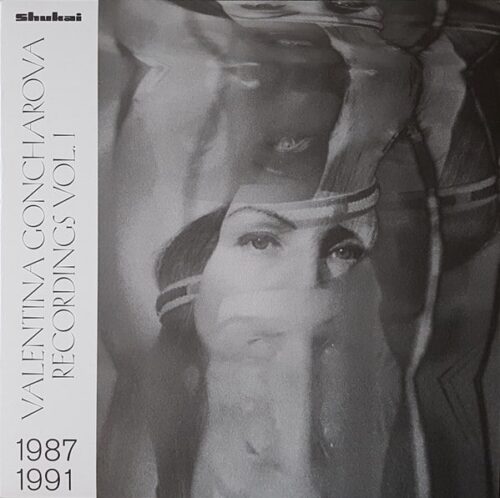
Although Goncharova had already featured in the catalogues of certain labels (Leo)13, the curators at Shukai managed to track down her lesser-known home recordings. Recordings 1987–1991 Vol. 1 (2020) features solo pieces in which the violin is enhanced with delay and electronics, with Eastern spirituality proving to be an important context. The composer encountered Buddhism whilst visiting a Buryat temple; she also attended numerous courses in esotericism and astrology. Some of the recordings are imbued with the spirit of incantation (Insight and Maitreya, featuring the sounds of bells and vocals), whilst references to nature also seem significant (Symphony of Wind, Garden of Zen). The most elaborate track on Goncharova’s first album is Metamorphoses – a composition of almost 20 minutes with a distinct arched form. It features concrete sounds (female vocalisation, violin pizzicatos), as well as various symbols (shepherd’s bells).
Recordings 1987–1991 Vol. 2 (2021) is dedicated to Valentina Goncharova’s duets, recorded in Tallinn, Riga, Helsinki and Moscow with Alexander Aksenov, Sergei Letov and Pekka Airaksinen. Reincarnation II with Aksenov features electric violin and saxophone phrases circulating through overtones and returning in waves, reminiscent of her previous album on Shukai. The next three Untitled sessions with Letov are more intense, at times even rough in sound (with the exception of the first, featuring low, drawn-out saxophone notes). The most surprising results come from Airaksinen’s collaboration with Goncharova14, where they venture into the realms of jazz-rock and psychedelia, weaving both bass riffs and haunting choruses into the narrative.
Before we turn to Svitlana Nianio, a brief digression on her collaborator (Forest Collection) Oleksandra Jurczenki, Oleksandr Yurchenko, who passed away in 2020 following a long illness. Shukai released his Recordings Vol 1: 1991–2001 (2023), which turns out to have a great deal in common with Goncharova’s work. Yurchenko also recorded at home and modified familiar instruments, such as a guitar into a sort of zither with pickups. It was on this instrument that, in the mid-1990s, he recorded the droning, rumbling and almost half-hour-long Count to 100. Symphony #1, full of detunings and reverbs. Extraordinary music for the difficult times of transition and chaos 15. The remaining tracks on the album reveal an unusual combination of Central Asian inspirations (the improvised form of the maqam) with New York minimal music, yet shrouded in an Eastern European mist – such as Merta Zara #3 or Playback #1.
From this perspective, singer Svitlana Nianio emerges as a pivotal figure in Ukrainian music. She gained recognition through her work with bands such as Puchnasti, Blemish and Susikhvazibida, as well as on the German music scene, and has also performed at Unsound. The Shukai catalogue features two albums on which she appears: solo Transilvania Smile (2023) and Recordings 1990–1993 with the band Cukor Bila Smert (2024). The first is a recording of the music for a 1994 performance by the Pentamonia dance group, recorded by Michael Springer in Cologne but never released. Nianio captivates here with the lightness of the motifs played on the harmonium and piano, unpretentious vocals, and a coherent yet evocative dreamlike aesthetic. It has much in common with Alice… in Bystriakova’s version, but also… with Yann Tiersen’s Amélie from 1997 (oh, if only Transilvania Smile had been released straight away!). As the artist herself said: “Personally, I imagined a misty landscape, incredible sea flowers, underwater gardens… Something from the world of dreams or tales of fantastical creatures”.

Cukier Biała Śmierć (Sugar White Death – ed.) was formed in the late 1980s by students at the Kyiv Conservatoire: Oleksandr Kochanovskyi, Tamila Mazur, Svitlana Nianio and Eugene Taran. The band recorded several albums at home, each named after a plant (rhododendrons, lilies, amaryllis), but these are now considered lost. Above all, they improvised and discussed a great deal, searching for their own sound, which Oleksii Dechtiar would later call ‘sugar calypso’ (which is particularly evident on Six Koral Devils). The album Shukai brings together material from scattered cassettes from the early 90s; some of them were, in fact, inspired by Włodzimierz Nakonieczny of KOKA Records16, and Nianio herself went on to influence the band Księżyc. Her vocals play a key role in all the songs, at times evoking an oriental, dreamlike quality (The Great Hen-Yuan River), at others fading into the reverberation (The Waltz Windows on the Floor). Taran’s guitar often introduces intriguing harmonic solutions (the Argolida suite), but also distinctive riffs (All Secrets of a Poem). It’s worth breaking the listening experience into a few parts, as the entire album comprises as many as 31 tracks and nearly an hour and a half of music – it can get a bit much.
To me, the contemporary Odessa-based girl band Chillera, signed to Muscut, seems to be a distant echo of Nianio and Taran’s work. The description of their debut single, SCHAX (2017) 17 perfectly captures the essence of this music: “three young witches have blended the fruits of surf rock, dub rhythms ripening in southern soil and the greenery of funk ornamentation. It sounds lush, natural, relaxing and, most importantly, fresh”. The aforementioned witches are bassist Ganna Bryżata, drummer Anastazija Marykuca and guitarist Polina Mackewycz. On Pro Fun (2019), funk is the dominant sound18, whilst the wonderful wah-wah takes us to some sunny islands (not necessarily on the Black Sea). During the almost hour-long atmospheric concert Live in Odessa (2021), the three young witches are joined by a very lively dog in the audience.
Equally, and perhaps even more interesting, are the solo projects of Chillera’s members. Polina Mackewycz as Mlin Platz 19 on the album Sunlimit (2019), she experiments with electronic, bass-heavy and dub sounds. She isn’t afraid of distortion (Toyota) or reggae rhythms (Noori Pussy), which, combined with light guitar work, creates a luminous atmosphere throughout. Far darker is Eye of Delirious (2023) recorded by bassist Ganna Bryzata as Bryozone after the full-scale Russian invasion of Ukraine had already begun. As the title of the second track (Sub Nautica) suggests, it is a sort of underwater voyage amongst the Glowing Sirens gliding by, deep into the ambient depths of the Black Sea. It’s impressive how, in these two tracks, the rhythms emerge and fade seamlessly into the ambient sounds, and how Bryozone skilfully balances the beats and basslines (the descent into the depths of Eye of Delirious). I’m really looking forward to her next album.
A misty sea and smoky ambients
In one interview, the members of Chillera spoke about a possible move from Odessa to Kyiv: “It’s wonderful to go there for a while, to experience all that’s going on, but it also drains your energy. To live there, you need to be more organised. We still can’t get our chaos under control.” What a beautiful tribute to local life! Is Odessa really that audible in their solo and group projects? Muscut’s producer notes and numerous reviews follow this Black Sea trail, but it becomes more pronounced on other albums. Take, for example, the music of Gennadiy Boychenko: in a duet with Nikolaienko (Ode to the Sea, 2016) or solo (Sea Songs, 2024). The first album20 takes its cue from the aesthetics of French (Assez d’eau!) and Soviet (Calming Waves) music libraries. These come into their own in the spacious reverberation or even surf-rock-style arrangements (Miracle, featuring Bryozone). Bojchenko’s four ‘sea songs’ 21 also convey the carefree spirit of summer, thanks to their rich tones (Entracte) and energetic rhythm (Grand Opening).
However, it is Paweł Miliakow’s second double-LP Odessia (2020), that truly reveals the depths of the Black Sea – a work so different from his earlier, claustrophobic Neumond (2016). Two ten-minute tracks frame shorter, more energetic pieces (Wave Dance with its looped beat). The first part of this four-part electronic symphony is Odessian Dub, which takes a sweeping sweep from a hypnotic bassline to crystalline soprano sounds. The finale, in turn, is an ambient calm in Odessian Night Sea – an intriguing conclusion to the form. This can be seen as a starting point for a journey all the way to the eastern coast of the Black Sea, namely to Georgia, where Rezo Glonti recorded his Subtropics (2023). Typical of Muscut, the warm, analogue, noisy and hazy sound 22 is like a nostalgic gaze into the past.
Set against the backdrop of all these hazy seascapes lies the steppe album Kobzareva Duma (2020) – An excerpt from a Shapoval Sextet concert at the Donetsk Jazz Festival in 1976. The first track Zbieraj się kozaku, będzie wyprawa, (Get ready, Cossack, there’s a journey ahead) begins with a recitation, followed by a frenetic fanfare from the whole band, which gives way to trumpet and saxophone motifs accompanied by a fusion rhythm section in the spirit of the Walther Report. The second track Matka Sicz (Mother Sich) is a lyrical interlude, with a slower tempo, brushes on the drums and trills from the wind instruments. The last surviving part Powrót (Comeback) still captivates with its psychedelic-free jazz opening, coloured by metallic percussion (Oleksandr Gurow), which transitions into the main theme with a wail from the leader’s saxophone, featuring a moving trumpet solo (Oleg Anapolski) midway through.
Oleksandr Shapoval himself, despite having graduated from mining college and working as an engineer, was also a leading figure on the Dnipro jazz scene, and is known today mainly for the folk-funk band Wodograj 23. However, it was Duma Kobziarza, inspired by the work of Taras Shevchenko (Kobziarz, 1840), that marked a true breakthrough, perhaps the first fusion of free jazz with Ukrainian poetry – and one that was emancipating itself from the then-dominant Russian language. It is all the more surprising that the recording went missing for over four decades, and the Shukai team literally unearthed it in one of the television studios. After less than half an hour, one can only guess what the whole concert might have looked like…
If Shukai is the archaeology of Ukrainian sound and Muscut is pseudo-archaeology, what exactly is being unearthed here, as seen in the profile picture? Judging by the solo projects of the heads of both labels, it could be an alternative history of the Ukrainian musical avant-garde – something along the lines of Aisteach, a fictional Irish archive conceived by Jennifer Walshe24. Nikolaienko has released four albums on his own label: The Sound of Pseudo-science (2015), Nostalgia Por Mesozóica (2022), Meta (2023) oraz Love-Fidelity or Hiss Goodbye (2025). On the latter, he used samples collected from friends – Ganna Bryzata, Memotone and Mykola Lebied – dedicating the album to everyone who has contributed to Muscut over the last 13 years. Let us hear from Nikolaienko himself, who describes his first two projects in these words:
[The Sound of Pseudo-science – note by JT] A playful and intriguing archive of sounds inspired by the work of pioneers and experimenters in electronic music. The album pays homage to the golden age of early electronic music, serving as a requiem and exploring themes of nostalgia through warm, analogue sounds straight out of the space age. For the artist, it is a strange and ironic sound document intended to show that electronic music can take on other forms today.
(…)
Nostalgia Por Mesozóica is an exploration of ‘experimental exoticism’ composed of synthesised tropical elements – an artificial landscape isolated behind a glass frame. Recalling recording techniques and sounds common in the 1960s and 1970s, this album could serve as the soundtrack to an exhibition on the Mesozoic era at your favourite natural history museum.
In another interview, Nikolaienko admits that he regards 1960s modernism as the golden age of music history, which subsequently developed ‘too quickly and failed to realise its potential’. Hence his motivation for his own creative work and for founding the Shukai and Muscat labels: to rectify the mistakes of the past and develop ideas that had been abandoned. But it is also about popularising Ukrainian achievements, for under different natural and political circumstances, a place like KijiwNaukFilm could well have been home to a Groupe de Recherche Musicales, a BBC Radiophonic Workshop or the Polish Radio Experimental Studio. Shapoval’s saxophone could have rivalled Ayler’s, and the Transilvania Smile album could have stood alongside the soundtrack to Amélie… The Sound of Pseudo-science is precisely such a tin found in the archives, filled with strange sounds from the space age, from the realm of filtered noise, sine wave synthesis and modulation of every kind. Tracks such as Solo for A or Gusev Effect could easily feature on the soundtrack of some sci-fi film from the Odessa studio (ah, if only we’d had the equipment back then!).
Subsequent albums offer yet more reinterpretations. Nostalgia Por Mesozóica reveals its intent right from the title of the opening track: Muzak for Mesozoic Showreel. It is, in fact, an attempt to create a cheap soundscape for a neglected natural history museum. Here, cliché follows cliché: birdsong and tribal percussion (The Ancient Musical Complex of Mammoth Bones), marimba passages from behind the rustling of leaves (Yalta). The whole thing is styled to resemble field recordings from thousands of years ago, unearthed from some grubby cassette. Meta, in turn, is a journey into the world of concrete music, but one based on the limitation of sound objects: the title consists of the first syllables of the words ‘metallophones’ and ‘tapes’. This is Nikolaienko’s most ambient and conceptual work, with which he attempts to match the ambitions of avant-garde artists from half a century ago, such as Bernard Parmegiani and Pierre Henry.
Finally, the latest album, Love-Fidelity or Hiss Goodbye, is a self-referential work, as it is based on samples from his own record label. It sounds like a musical farewell (Hiss Goodbye), doesn’t it? Even if it is, it features solid, multi-layered loops and that characteristic warm Muscut sound (Belated Processions). Indeed, according to an announcement from March 202525, Muscut is switching to ‘archive mode’, continuing to sell previous albums but putting the preparation of new ones on hold. Will another half-century have to pass and a new generation of diggers emerge to find the missing boxes of tapes in their archive? The titles of the last two tracks on Nikolaienka’s cassette might provide a clue: How to Get to the Library? and Sorry for (Tape) Delay.
See Kasia Jaroch, ‘Praktyka duchologiczna’, Dwutygodnik, no. 298, 2021, www.dwutygodnik.com/artykul/9287-praktyka-duchologiczna.html, accessed here and hereinafter on 10 April 2026. ↩
Viktoria Yakobchuk, How the Shukai label unearthed the soundtrack to 1960s Ukrainian science fiction, ‘Amnesia’, 29 March 2019, amnesia.in.ua/vlasov-shukai, own translation here and below. ↩
Nastya Kalita, Katerina Yakovlenko, ‘Music that never existed for the listener’: on the archive label ‘Shukai’, ‘Support Your Art’, 13 March 2020, supportyourart.com/conversations/shukai/ ↩
See Alexander Belyaev, “Encyclopaedia of Fantasy”, 28 June 2016, www.encyklopediafantastyki.pl/index.php?title=Aleksander_Bielajew ↩
SHUKAI – Victor Vlasov Interview, Dmitro Prutkin, 5 April 2019, www.youtube.com/watch?v=aoYSKH9sXHE. ↩
W. Jakobczuk, Kak lejbel Shukai…, op. cit. ↩
Alice Through the Looking Glass. Complete series. Animated film based on Lewis Carroll’s fairy tale (1981), Soviet Humour, 14 April 2025, www.youtube.com/watch?v=bFORD1QSQMk ↩
Clannad – Legend (Robin of Sherwood Soundtrack), Stribogh, 23 August 2014, www.youtube.com/watch?v=rtu8o6yc5jA. ↩
Volodymyr Bystriakov – Battlefield (FULL EP, electronic / soundtrack, Ukraine, USSR, 1986), Funked Up East, 4 June 2021, www.youtube.com/watch?v=47ywsxF0EL0. ↩
Kalita, K. Yakovlenko, ‘Muzika, jaka nikoli…’, op. cit. ↩
Jan Topolski, Parallel Worlds (8) Valentyna Goncharova (#1953), ‘Ruch Muzyczny’, #11/2021, 8 June 2021, ruchmuzyczny.pl/article/1142-swiaty-rownolegle-8-walentyna-gonczarowa-. ↩
Lucia Udvardyova, The sonic explorations of Valentina Goncharova, ‘Unearthing the Music’, unearthingthemusic.eu/posts/the-sonic-explorations-of-valentina-goncharova. ↩
Valentina Goncharova – Ocean (FULL ALBUM, ambient / experimental, Estonia, USSR, 1989-2022), Funked Up East, 13.05.2022, www.youtube.com/watch?v=2AkpbfkeU_o. ↩
Valentina Goncharova – Recordings 1987-1991 Vol.2 (FULL ALBUM, experimental, Estonia/ Ukraine, USSR), Funked Up East, 11 December 2021, 11.12.2021, www.youtube.com/watch?v=FBFL6CQZF_o&list=RDFBFL6CQZF_o&start_radio=1. ↩
Count to 100. Symphony #1 (edit 2001), Oleksandr Yurchenko – feature, 1 June 2023, www.youtube.com/watch?v=migAEX4GbNg. ↩
Patryk Zakrzewski, Włodzimierz Nakonieczny: Mieliśmy bzika na punkcie ukraińskiej muzyki [WYWIAD], „Culture.pl”, 11.08.2022, culture.pl/pl/artykul/wlodzimierz-nakonieczny-mielismy-bzika-na-punkcie-ukrainskiej-muzyki-wywiad. ↩
Chillera – SCHAX (7″ vinyl), Muscut, muscut.org/releases/m8. ↩
Chillera – Pro Fun (10″, 2019) Excerpts, Muscut, Soundcloud, 24 August 2019, soundcloud.com/muscut/chillera-pro-fun-10-2019-excerpts?in=wawotsch% 2Fsets%2Fdie-neue. ↩
Mlin Patz – Sunlimit (12″, 2019) Excerpts, Muscut, Soundcloud, 6 September 2019, soundcloud.com/muscut/mlin-patz-sunlimit-12-2019?in=3jltv2yg6uae/sets/two-2. ↩
Ode To The Sea by Indirect & Nikolaienko (12″, Nov 2016), Muscut, Soundcloud, 25.11.2016, soundcloud.com/muscut/sets/ode-to-the-sea-by-indirect. ↩
Hennadii Boichenko – Sea Songs, Discogs, www.discogs.com/release/31005463-Hennadii-Boichenko -Sea-Songs?srsltid=AfmBOor9DTLIEHaiLQHUaHyNbAR7QFmG7fYYrwdnBSRO7KzoobkEXm2Y. ↩
Rezo Glonti – Subtropics (Full Album), Tape Counter, 3 March 2023, www.youtube.com/watch?v=rPnba0S1Yvo. ↩
Wodograj S62-14083-4. chud. ruk. Oleksandr Shapoval, Maribor, 6 June 2019, www.youtube.com/watch?v=lo28mpsgXHs. ↩
Cf. Antoni Michnik, Aisteach – the potential avant-garde, ‘Konteksty’, vol. 349, no. 2, 2025, pp. 75–86, bibliotekanauki.pl/articles/63513125. ↩
Muscut, Bandcamp, 6 March 2025, muscut.bandcamp.com/community?sid=1746043& st=sm. ↩