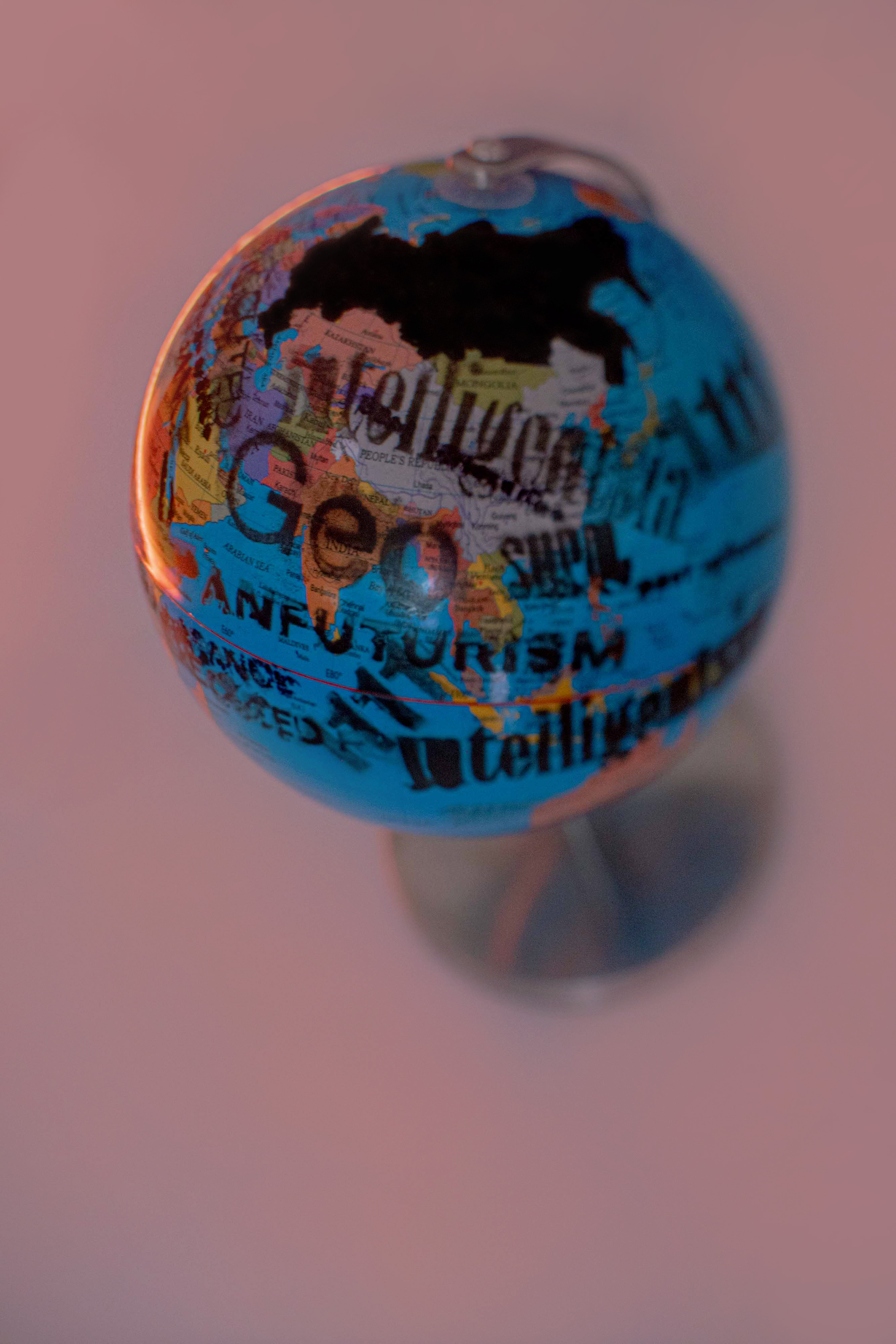
Crashing reality globe
Words Through Music: Focusing on Ukraine’s Executed Renaissance
As a composer, I’ve almost always drawn my inspiration not from music, but mainly from visual art, poetry, or completely abstract concepts. The beginning of the full-scale Russian invasion happened at the time I was entering early adulthood, and I became both more politically aware and more fascinated by our culture in all its aspects. Unfortunately, my teenage self was not as conscious. The truly invaluable pieces of literature, poetry, or visual art studied in school seemed to be anything but mere assignments at the time. So, growing older and gaining broader perspectives while also observing the horrors of war, I became rather upset by my past ignorance and was determined to direct my own work towards the heritage that now looked so different in my eyes.
Surely, the crashing reality of Russia trying to wipe my country and all of its legacy off the face of the earth has served as an effective push, especially when comprehending how long this process has actually been going on. However, as an artist myself, taught to analyze and consume any art critically, I was genuinely compelled by the content of what I was exploring, this time purposefully, by my own will, and with gratitude for having access to what has survived to this day.
Given my personal interest in modernist-era art and considering what an acute period it was for Ukrainian identity, the first material I turned towards was the literature of the Executed Renaissance. This name was given to a generation of artists completely removed in a wave of Stalinist repressions in the 1930s as a “nationalistic threat” to the Soviet regime. Over a few years, across the territory of the Soviet Union in general, these repressions exterminated thousands of members of the intelligentsia, people of culture and science. For Ukrainian art history, the key dates and the main tragedy of this period remain October 27th to November 4th, 1937 – a mass execution of 1111 political prisoners in Sandarmokh as a celebration of the Bolshevik Revolution anniversary, with various artists and literary authors among them.
The transition into the Soviet Union was a complex time for many Ukrainians who strived for national freedom, and in the 1920s the new government introduced a scheme of so-called “Ukrainization”, meant to significantly loosen control over Ukraine’s autonomy and national expression – in language, publishing, cultural manifestations, etc. This political move indeed proved to be effective, and many of the brightest minds, at that time full of hope for a different future away from imperial Russia, were happy to fight for what seemed promising enough to make that dream a reality.
A group of young and progressive writers, brought together by Mykola Khvyliovyi, founded VAPLITE (Free Academy of Proletarian Literature), which followed the main principles of communist ideology but also clearly demonstrated a rejection of any Russian influence, with Khvyliovyi’s famous motto: “Away from Moscow!”. Surely, such sentiments could not be tolerated for long. As the grasp of the Bolshevik iron claws strengthened towards the end of the 1920s, the partial freedoms of “Ukrainization” quickly came to an end, VAPLITE had to terminate its activity, and starting from 1933 a wave of arrests swept away almost all of its members. Khvyliovyi’s suicide followed the arrest of his close friend Mykhailo Yalovyi, a poet-futurist who went by the pseudonym Yulian Shpol – one of those later executed in Sandarmokh.
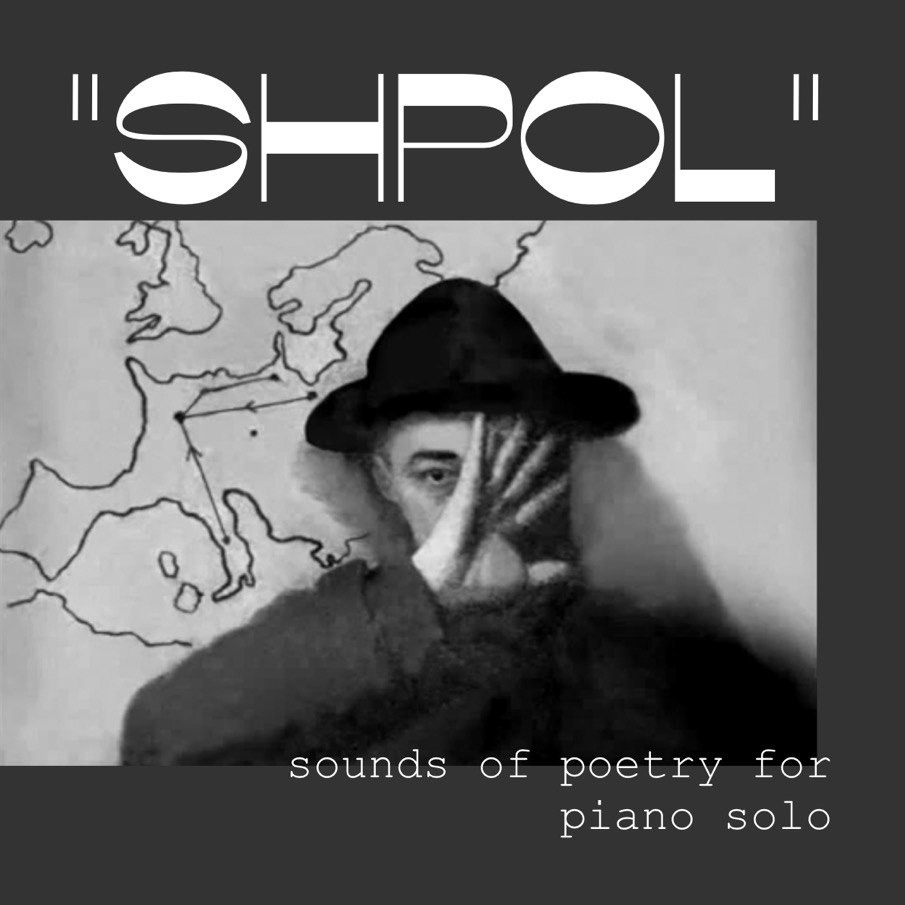
“SHPOL”: sounds of poetry for piano solo
My first work from this series uses one of his unnamed poems and is titled in the best way it can simply commemorate him: Shpol.
I have always been deeply fascinated by language and words in general, and especially by the Ukrainian language. Rationally – because of its Slavic structural intricacy, and less consciously – perhaps because a mother tongue does feel close to the heart and to our ways of expressing things.
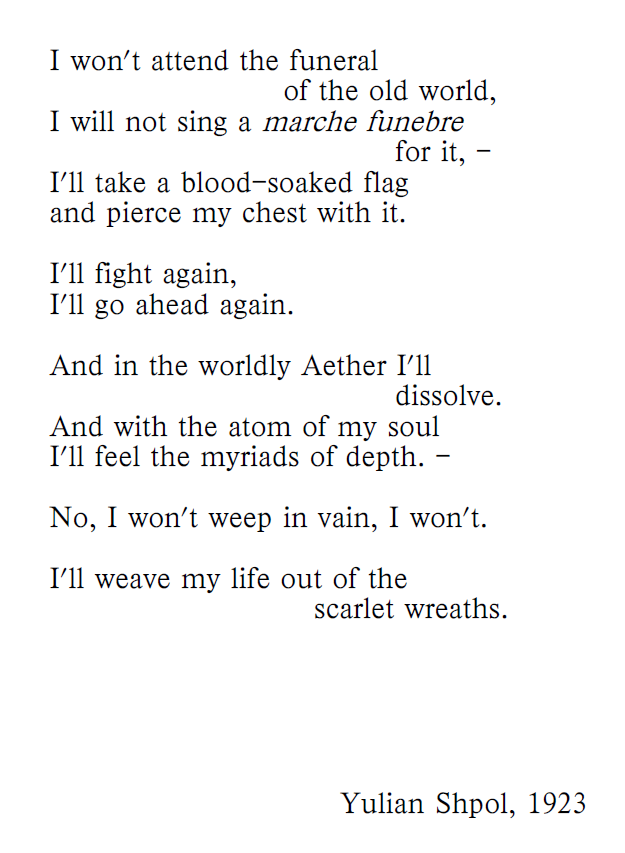
It is quite hard to explain why poetry attracts me so much, both on its own and in musical contexts. It could be a need to create music, an inherently abstract medium, around a more concrete, non-abstract concept. But mainly, good poetry just fascinates me as it is, and some of it I would definitely never dare to spoil with music. That is exactly the case with Shpol’s poem – I did not manipulate it or incorporate it into the music in any way. Instead, this poem remains untouched and only stands as a sort of epigraph to a one-movement work for piano solo, being the source of the music’s content and spirit. You could call it a transcription of the words into a more abstract language.
Firstly, I translated the poem from Ukrainian to English, trying my best to preserve its essence and stylistic quality.
Shpol had only ever published one poetry book titled Verkhy (“The Tops”). His writing style, while being a great example of the era’s futurist movement, is individually best characterized as an ongoing, determined fight on the way to a, nevertheless, inevitable end in doom and darkness – quite an embodiment of the author’s life itself.
To me, this particular poem felt like a quick but sweeping force compressed into just a few lines – the masterfully assembled words so precisely manifest a naked, genuine spirit through their sense and rhythm. This profound spirit, or perhaps the striking way it appeared on paper, was really what drove me to relive it in my own way – through music.
The video below is a performance of SHPOL by an astounding interpreter of new music and my dear piano professor from the Royal College of Music in London, Andrew Zolinsky.
This work was one of my first attempts to expand the variety of tonal and pitch organization in my musical language, as earlier it had consisted either of unorganized, intuitive atonality or partial serialism. I wanted the heart of this piece to be a naturally occurring, simple melody built on the intonations of sorrowful Ukrainian songs. It is not based on any particular song, but rather accumulates echoes of traditional ballads sung while mourning deceased soldiers or loved ones – a certain marche funèbre that the poem mentions. It starts and ends the piece, also appearing in a slightly modified form in the middle, and acts as the tonal arc of the work that stands its ground while the rest fissures apart into dark and dissonant sounds, leaving behind any sense of clarity.
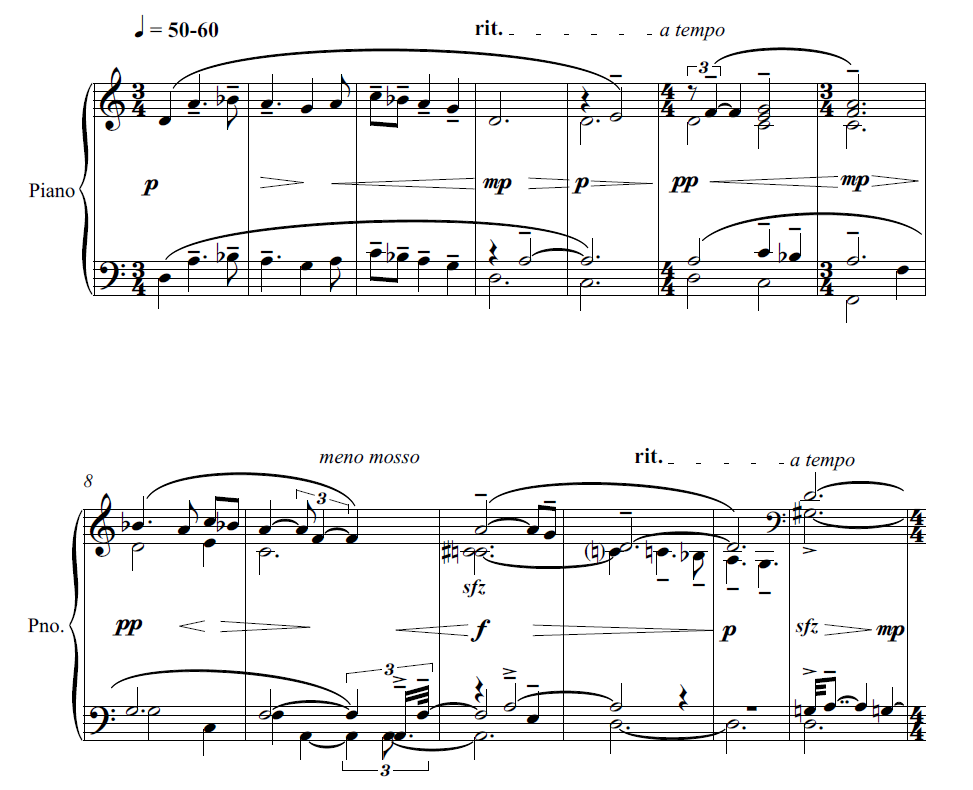
Another important element, responsible for the piercing, texture-shattering moments, is a rather distorted imitation of bells in Orthodox churches. I generally have a fascination with church bells; I believe their sound to be an almost powerful archetype that evokes an unexplainable genetic memory in Ukrainian people, regardless of faith or location. Here, I wanted to create a cluster-like, rather heinous soundscape of bells, similar to that in Ligeti’s The Devil’s Staircase étude.
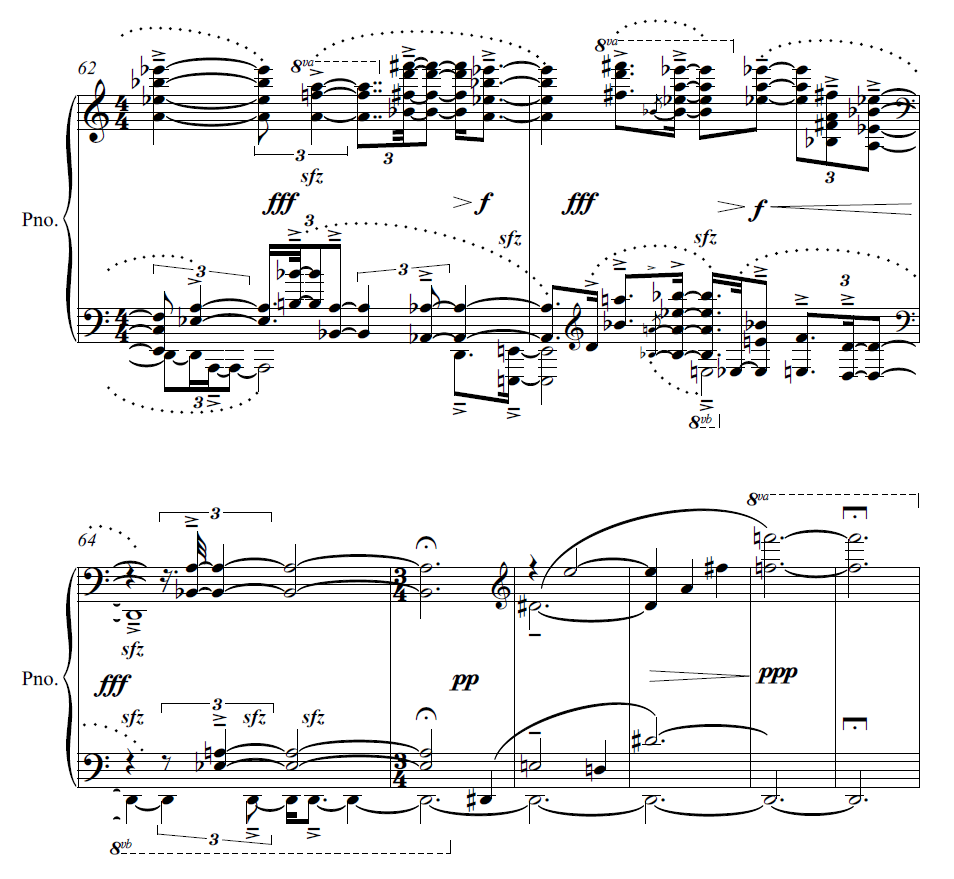
The third outburst of the bells ends with a descent into the very bottom of the keyboard and a repeated strike on the lowest “D” key, which resembles a kind of final, fatal chime lingering on for a long time with the pedal. After a pause, the marche funèbre slowly emerges again and ends the piece, fading away into silence.
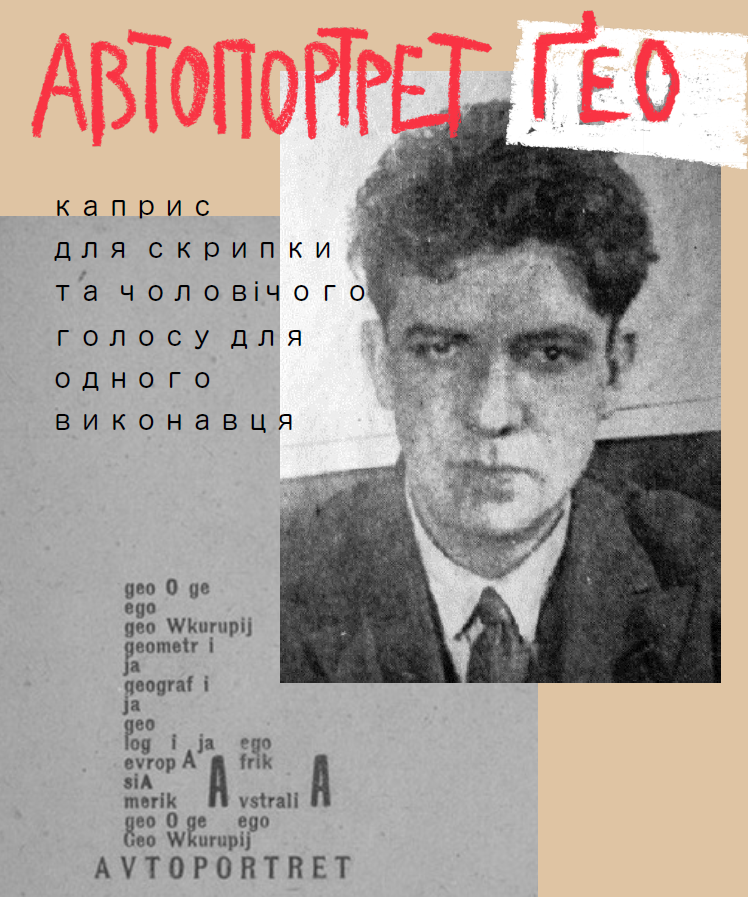
GEO’s AVTOPORTRET: caprice for violin and voice of one performer
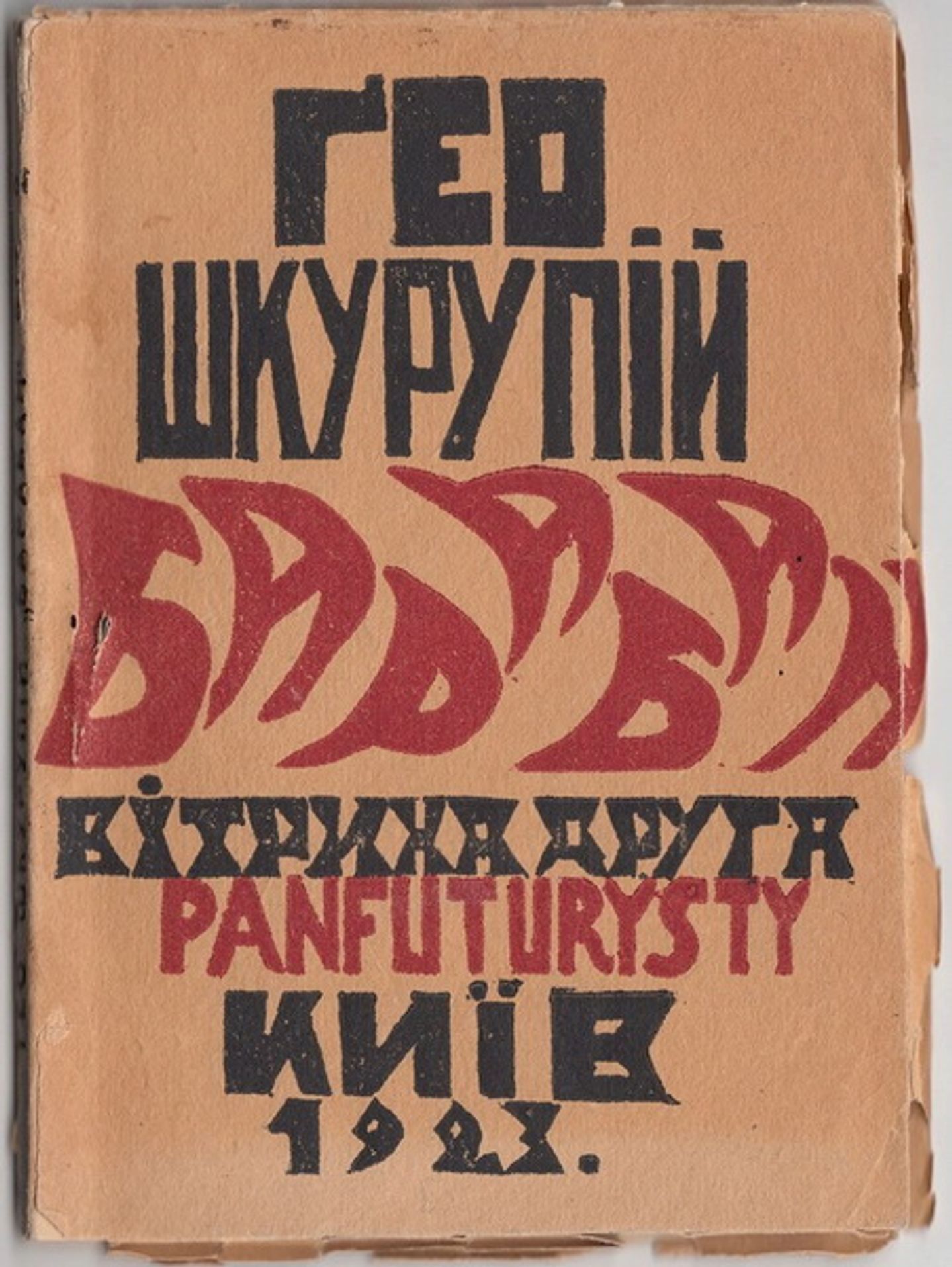
The second piece from this Executed Renaissance opus features a poem by another author: Heorhii Shkurupii. This one went by an even odder pen name – Geo – which seemed to become an important part of Heorhii’s identity rather than just a pseudonym. In Ukrainian, “Geo” would be written using the then-trendy letter “Ґ” among young litterateurs, unlike the regular “Г” without the upward hook. In addition to this, Geo would also modestly sign his works as “The King of the Futuroprairies”, which referred to his self-proclaimed leadership in Ukraine’s futurist poetry movement. He even coined a term for his own sub-movement, “panfuturism”, meant to be unique to the Ukrainian school in contrast to the Russian one of the time. He didn’t stop there, though, also liking to experiment visually and create his own book cover designs.
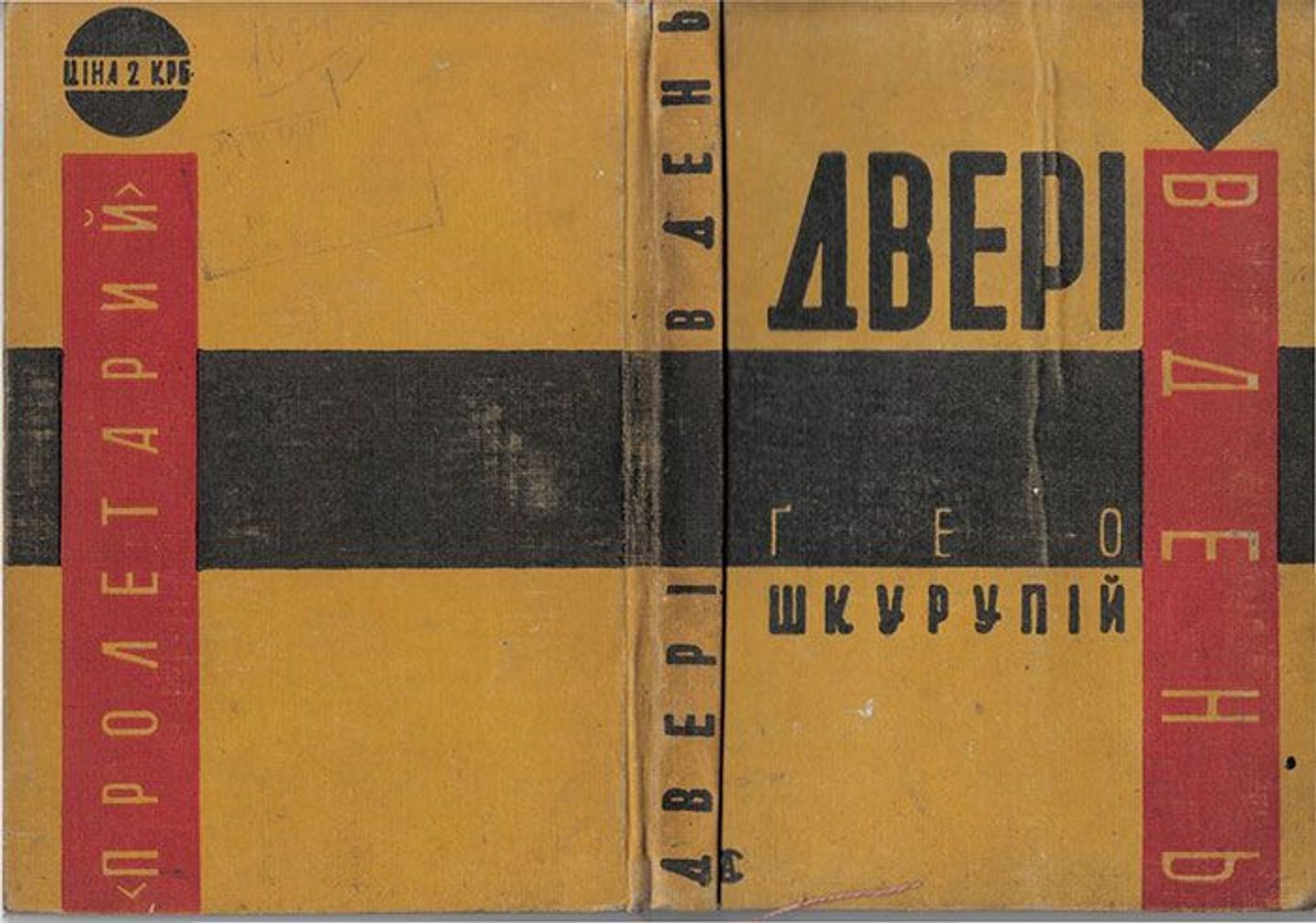
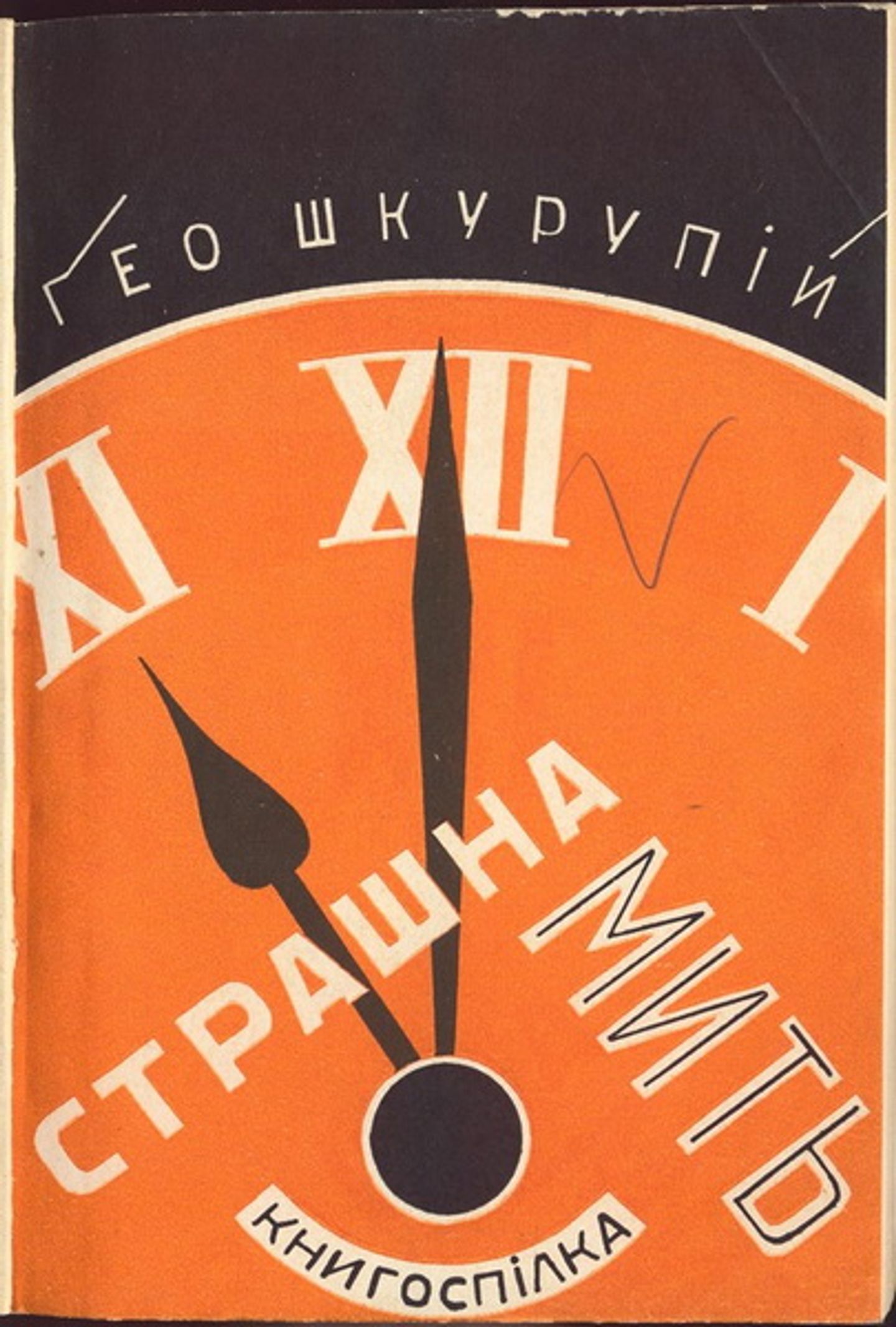
Other than being quite the embodiment of eccentricity and innovation, he had, just like the other “VAPLITE” members, a very clear stance on his identity as a Ukrainian and actively voiced the importance of detachment from Russian literary tendencies in favor of European ones. Unfortunately, the poet’s life was cut short at just 34 years old by the Soviet NKVD (the forerunner of the KGB). Shkurupii was arrested in 1934 and executed three years later along with 509 other prisoners from the Solovki concentration camp.
Here is a poem titled “Avtoportret” (“Self-portrait”) from Geo’s debut collection Psychetosy, which my next composition is based on. Unlike the one by Yulian Shpol, which I didn’t dare manipulate in any way, this one looked like it was literally made to be turned into sound and go far beyond being trapped on paper – to understand what I mean, it is enough to glance at the poem itself the way Geo designed it.
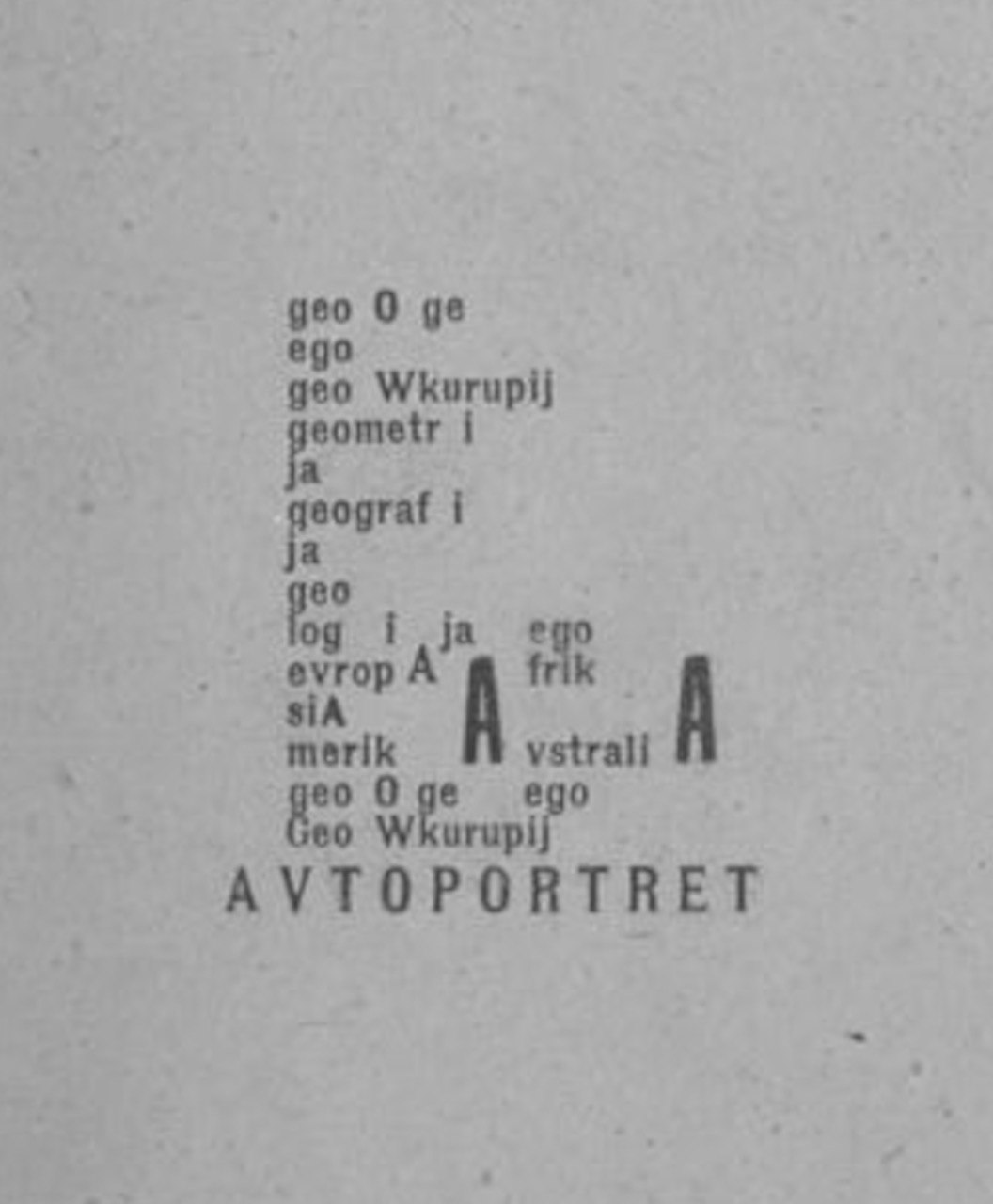
Surely, the first striking thing is the unconventional notation and placement/sizes of the words. The second thing, though, is the fact that these words are written using the Latin alphabet rather than Cyrillic – another mark of “panfuturism” striving toward the Western world. But which words exactly is he using, and what does he do with them? Easily recognizable in almost any European language, “Avstralia”, “Amerika”, “Evropa”, “geografija”, and “geologija” are chopped up into stuttering syllables and exclamations. Last but not least, there’s the core element – the repeating author’s name, “Geo”, stubbornly establishing itself over and over again among the worldwide titles. And not only in its original form – Shkurupii plays around with the order of those three letters, turning “Geo” into “ego”. It is a self-portrait after all!
Onto the music: the idea of a solo performer playing and using their voice to “recite” the poem at the same time was born in collaboration with the Ukrainian legend of contemporary violin, Orest Smovzh. The piece was later recorded in Orest’s performance as part of the Kyiv Contemporary Music Days, with support from the Per Forma grant program.
Here is how the performance notes in the score explain the different uses of voice.
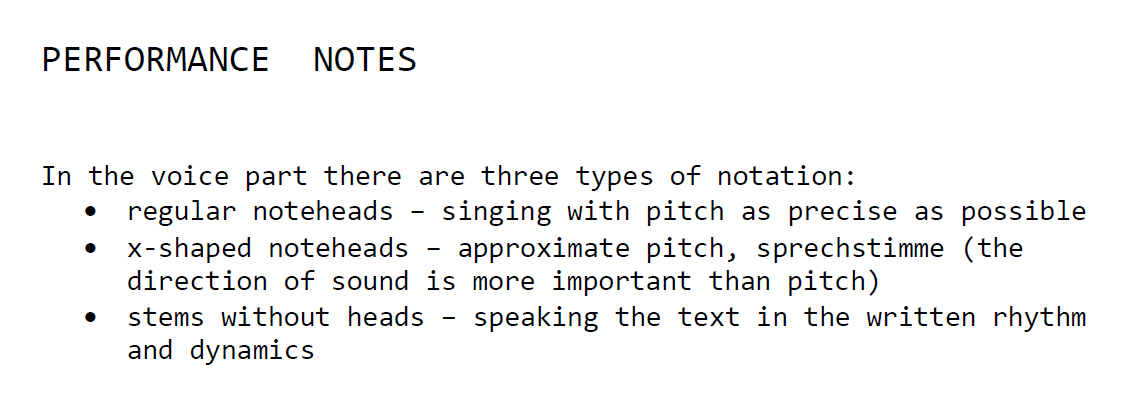
Besides “reciting” the complete text of the poem, the part also includes some noises that just felt natural to occur from the character, created in the momentum together with the violin. The idea was for the violin and voice parts to coexist organically, without one being more important than the other.
I introduced a few musical elements that support the architecture of the piece, which had already been made important visually by the author.
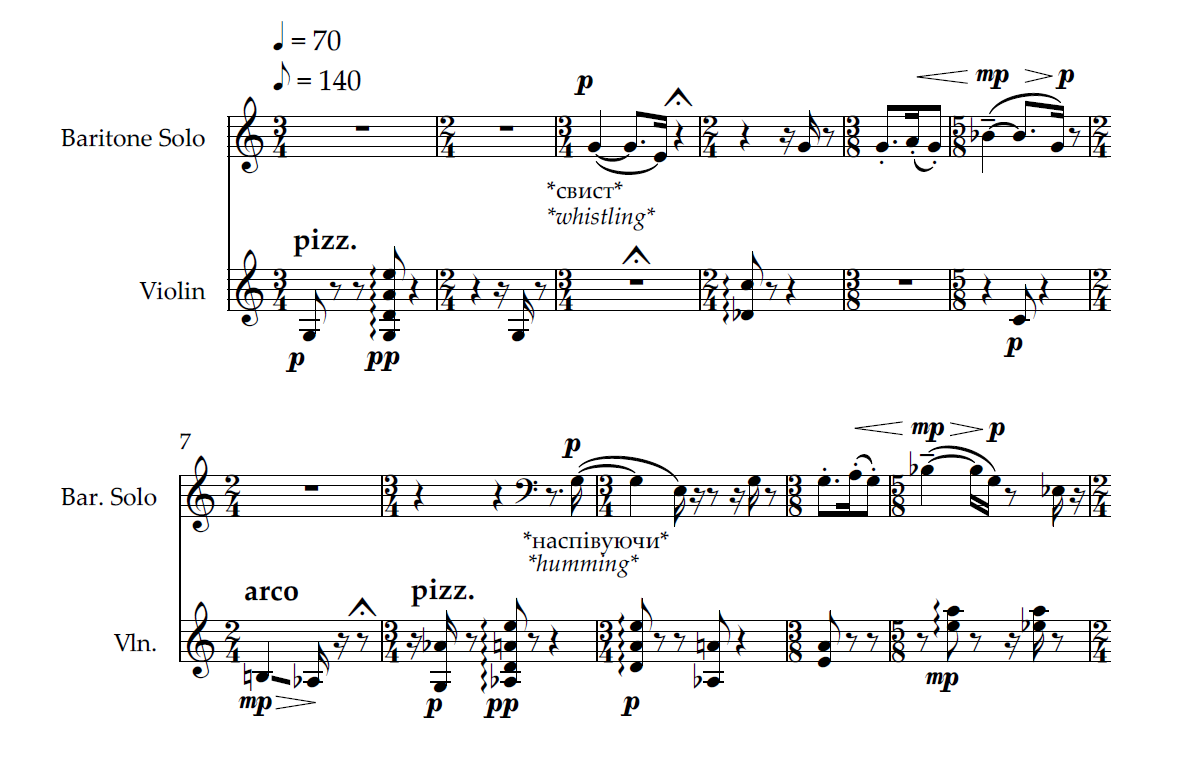
Framing the beginning and the ending, there is a sort of leitmotif: a simple tune that the performer whistles and hums.
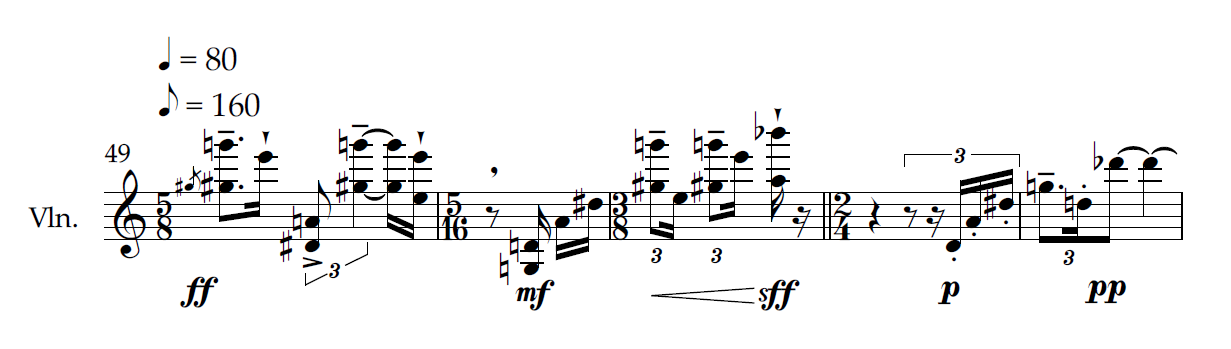
Some of its melodic elements reappear later with different expressions, such as this ascending, “swinging” minor third in a climactic violin cadenza.
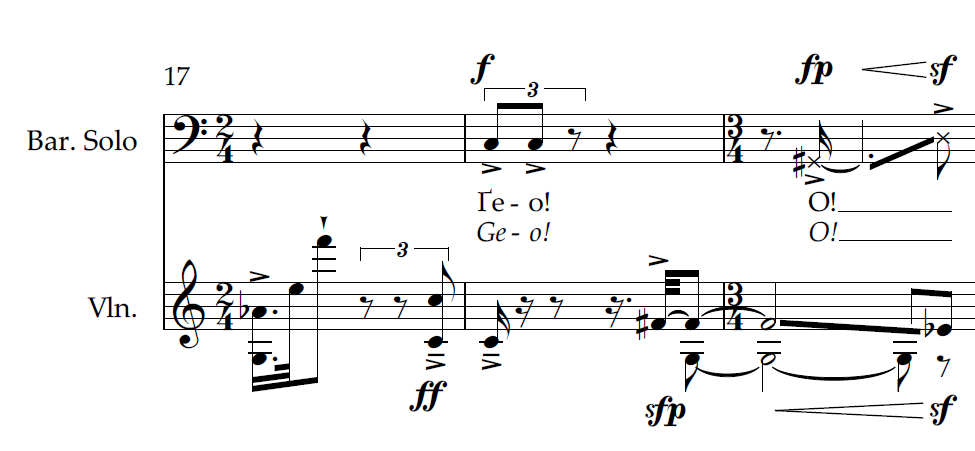
This tune feels light, easy-going, and even elegant in contrast to the fiercer and more assertive elements without which Geo’s spirit would not be complete. For example, the essential “Geo” and “ego” sometimes come as bold exclamations, with repeating accents and reciprocal imitation of the same raging energy in the violin.
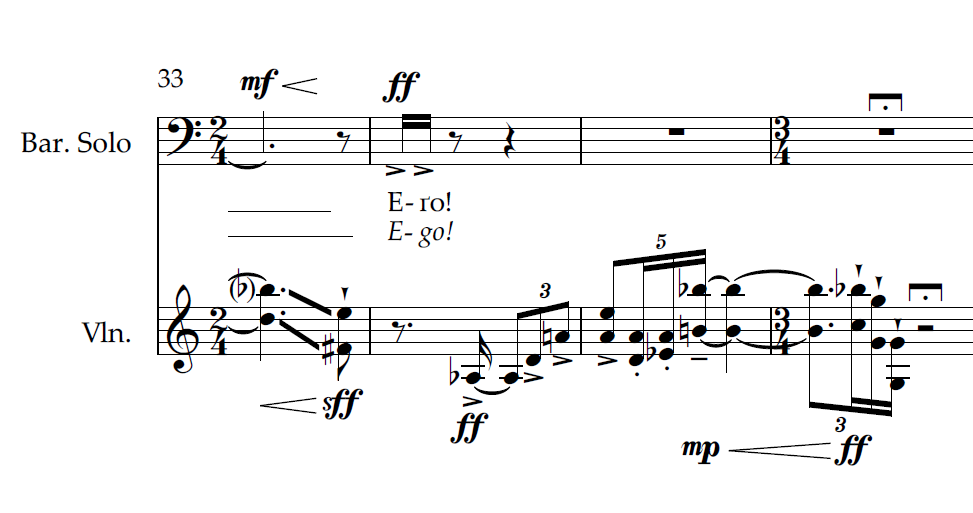
Overall, the material here combines flamboyant and virtuosic elements of a traditional caprice with eccentric violin-and-voice combinations, signature melodic motives, and moments of more stagnant energy – the rapid changes of mood are surely one of the key qualities of a caprice. In fact, with “Geo’s Avtoportret” I did not want to focus on the sense of drama or tragedy like in the previous poem by Shpol, where this trait was an inseparable source of its spirit. Here, I was rather looking to embody Shkurupii’s – although purposely performative, yet in that very way authentic – artistic personality, using what he had already presented to us himself. And to me, it brings together the one-of-a-kind qualities of an eternally young genius with a spirit of life and rebellion. I could say this work is my own depiction of his “self-portrait”, filtered through the personal perspective of a musician and a modest fanatic of Ukrainian poetry.
I have a strong desire to keep creating music that grows out of foundational, native words and sounds – from the main creation and soul of my people. And although it is, first and foremost, their profound quality and artistic influence that draw me to them, with this music I also want to serve the incredible works of artists who weren’t given the first chance to live. Maybe this way, their art will get a second one.