Creative bird seed
Between Worlds: How DZ’OB Connects Academia and Techno
It is often said that birds and music are the purest forms of freedom. A fitting credo for an ensemble bearing the name DZ’OB, whose compositions in the genre of electroacoustic IDM (intelligent dance music) are unique not only on the Ukrainian scene but also within the broader European context.
Founded in 2014, the group today functions as an ensemble of four instrumentalists using oboe (Vasyl Starshynov), bassoon (Oleksii Starshynov), violin (Iryna Li), cello (Oleksii Badin, artistic director), and electronics —synthesizing contemporary dance music with academic traditions. Classical music, IDM, techno, dubstep, minimalism: this high-level hybrid blurs the boundaries between epochs and traditions, subtly inviting listeners toward intellectually engaged listening. Drawing inspiration from Aphex Twin alongside Baroque and Classical composers such as Haydn, the ensemble’s repertoire consists of original works (by Oleksii Badin and Maksym Andruh) as well as pieces created in collaboration with contemporary composers. What follows is the story of DZ’OB, in the words of Oleksii Badin himself:
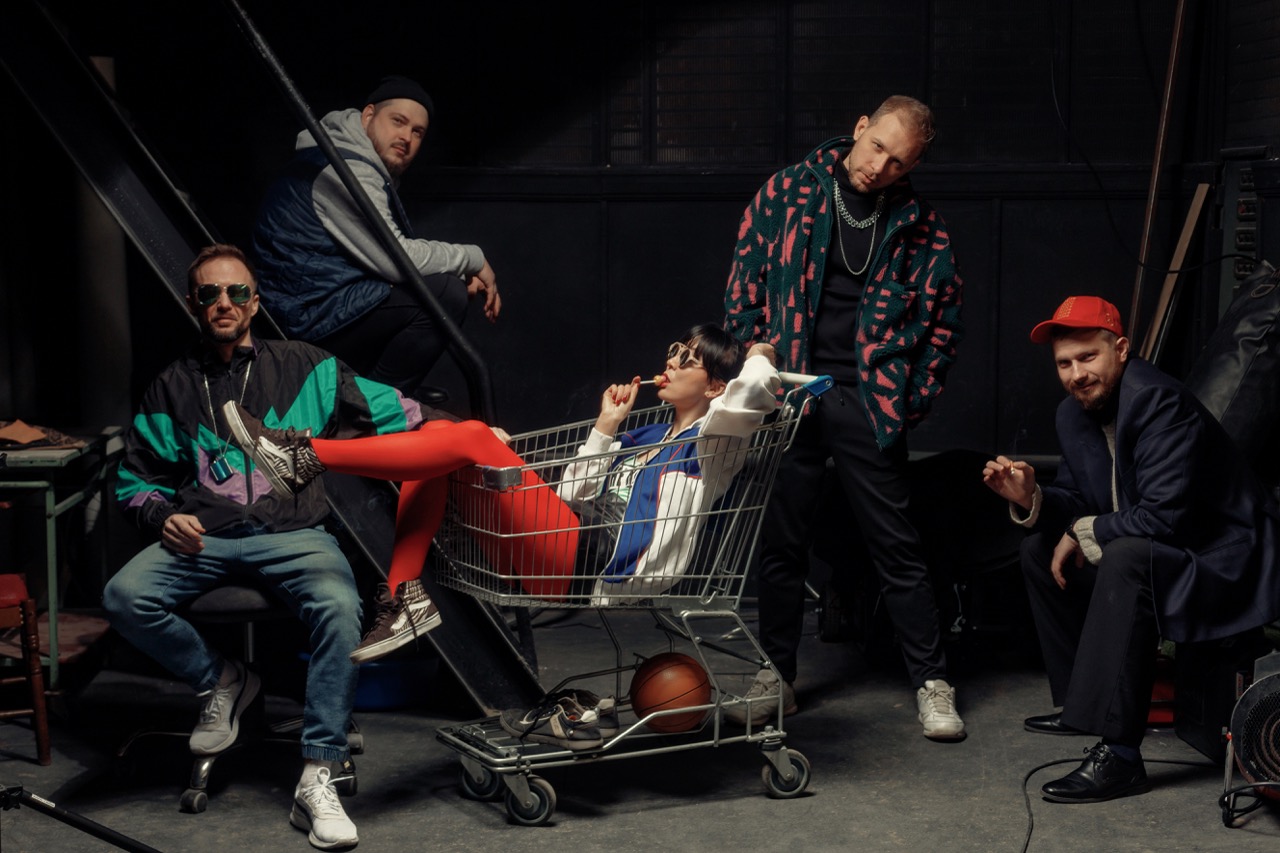
DZ’OB ensemble
ОB: “All of us were born in Dnipro. I met Maksym much earlier, when we were studying at the Highschool of Information Technologies, while I met the other musicians later at the conservatory.
My parents very much wanted me to have a “normal” profession, so I graduated from the Faculty of Mechanics and Mathematics. When I was finally able to decide for myself, I enrolled in a music college — during my third year at university. By the way, it was great to receive two scholarships at once. After that, I entered the conservatory.
I believed that the conservatory was necessary for my further development as an instrumentalist. At the same time, of course, our conservatories are somewhat in crisis when it comes to training contemporary musicians. I remember that when I was still in music college and recording Giovanni Sollima’s Violoncelles, vibrez! on cassette tapes (even though the internet already existed), people reacted as if it were something strange. Even music from the first half of the twentieth century — Milhaud, Poulenc, Hindemith — which I was interested in at the time, was perceived as extremely “modern.”
Dnipro carries a distinct industrial afterimage. For a long time, the city was closed due to the presence of the KB Pivdenne, an enterprise responsible for the development and operation of rocket and space technology. The faculty where I studied trained specialists who were supposed to design rockets. This is a deeply preserved city with its own specificity — a city of steel and rolling mills, as my grandfather used to say. He himself worked at an institute that produced pressure vessels, including those for nuclear submarines. Under the influence of Dnipro, our worldview was shaped, especially in the 2000s. At that time, the city had a very vivid electronic scene — electronic dance music, raves in abandoned factories, basements, bomb shelters. Our small circle exchanged recordings of electronic and contemporary academic music, films. It was a scene that shaped everything.
Initially, Oleksii planned to create a large ensemble: violin, cello, oboe, bassoon, saxophone, later clarinet, and electronics. In this format, DZ’OB played its first concerts. Maintaining stable activity proved extremely difficult, so today the lineup has been reduced to a quartet.”
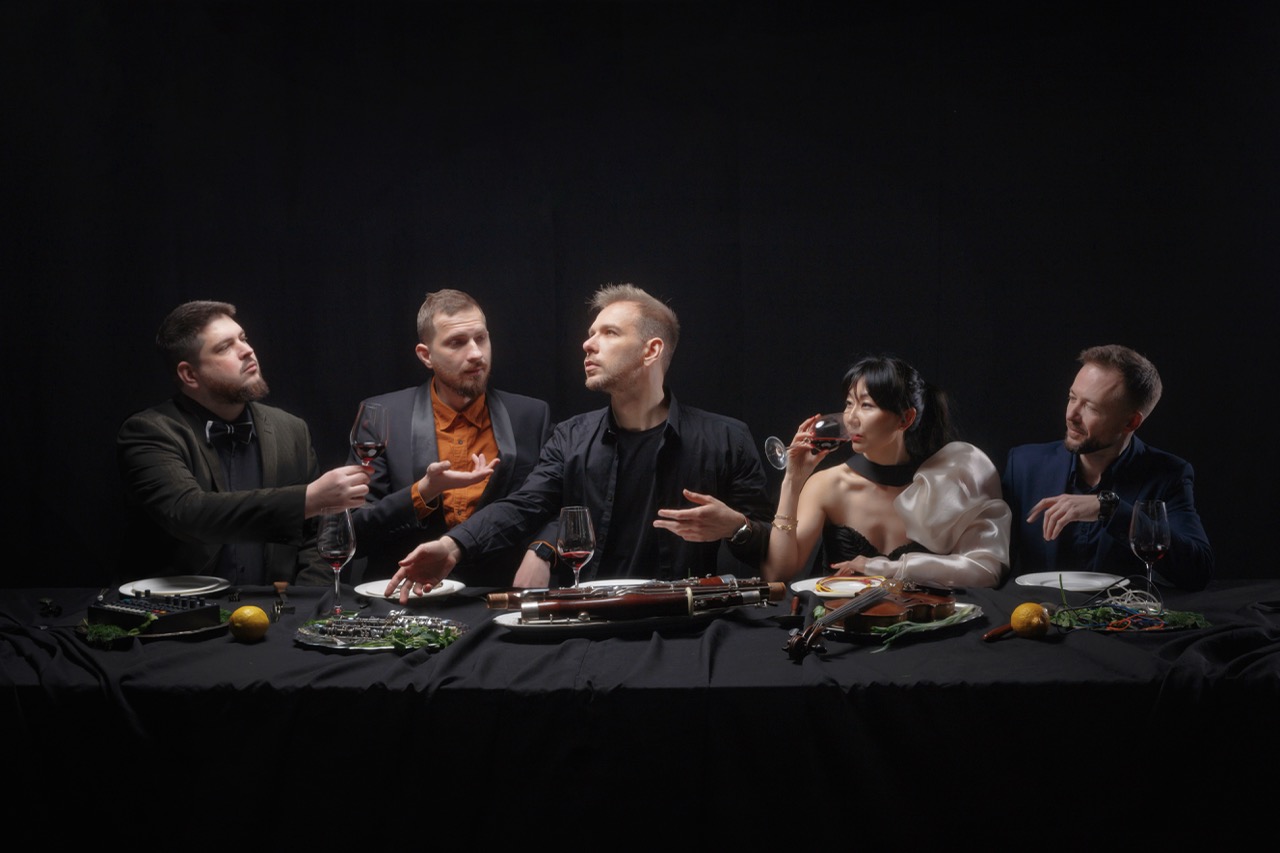
DZ’OB ensemble, fot. Max Timopheev
Oleksii openly admits that being a musician is only half the work. Alongside creativity, he simultaneously became manager, PR agent, producer, booking agent, and SMM specialist. This multitasking bore fruit: the ensemble has gained recognition on the international stage. As early as 2019, DZ’OB performed in Vienna with the support of the Ukrainian Institute, followed by an appearance at Eurosonic Festival in early 2020. Then the pandemic intervened, followed by the full-scale war. Since 2022, most concerts have taken place abroad (with only a few performances in Lviv in Ukraine during that time). In 2025, DZ’OB participated in the prestigious Classical:NEXT showcase. According to Оleksii, such forums are extremely important: the organizers proved open and oriented toward a broader concept of “art music,” free from rigid academicism, which made the ensemble feel comfortable. Among the participants, he recalls an octet of Icelandic flutists who collaborated with Björk.
Thus, the European context proves favorable for the ensemble’s development: such genre hybrids and boundary experiments are increasingly becoming the norm. In Ukraine, however, the first harbinger (or perhaps the mockingbird) was DZ’OB. The ensemble is often called the undisputed leader of the local avant-garde scene, having participated in nearly all Ukrainian festivals within their field: Leopolis Jazz, Bouquet Kyiv Stage, LvivMozArt, Koktebel Jazz Festival, Hedonism Festival, Plan B, Am I Jazz, Jazz on the Dnieper, and others.
Today, the metaphor of a bird capable of mimicking the voices of its environment resonates with renewed depth. DZ’OB not only operates in a cross-genre dimension, lightly brushing both Baroque music and Squarepusher with a single wingbeat. With acute sensitivity, the ensemble captures ideas of experimental “fresh air” and conveys them to listeners in a masterful flight, like for example, through their new album.
The Playground
The fourth album in DZ’OB’s discography, released in spring 2025, became a significant addition to the mosaic of the new Ukrainian scene, which is experiencing a renaissance against the backdrop of war. The musicians succeeded in articulating reality within a complex artistic dimension. On the new album, DZ’OB advances even further in its search for an original yet recognizable sound. The familiar pulsation of the industrial city and fractured techno rhythms create a distinctive atmosphere that becomes increasingly dramatized with each successive track.
The compositions were created using short fragments of music originally written as a soundtrack for a 1929 silent film commissioned by the Dovzhenko Centre (a state film archive). The film, Sketches of a Soviet City, is a propaganda piece, yet at the same time a valuable historical document.
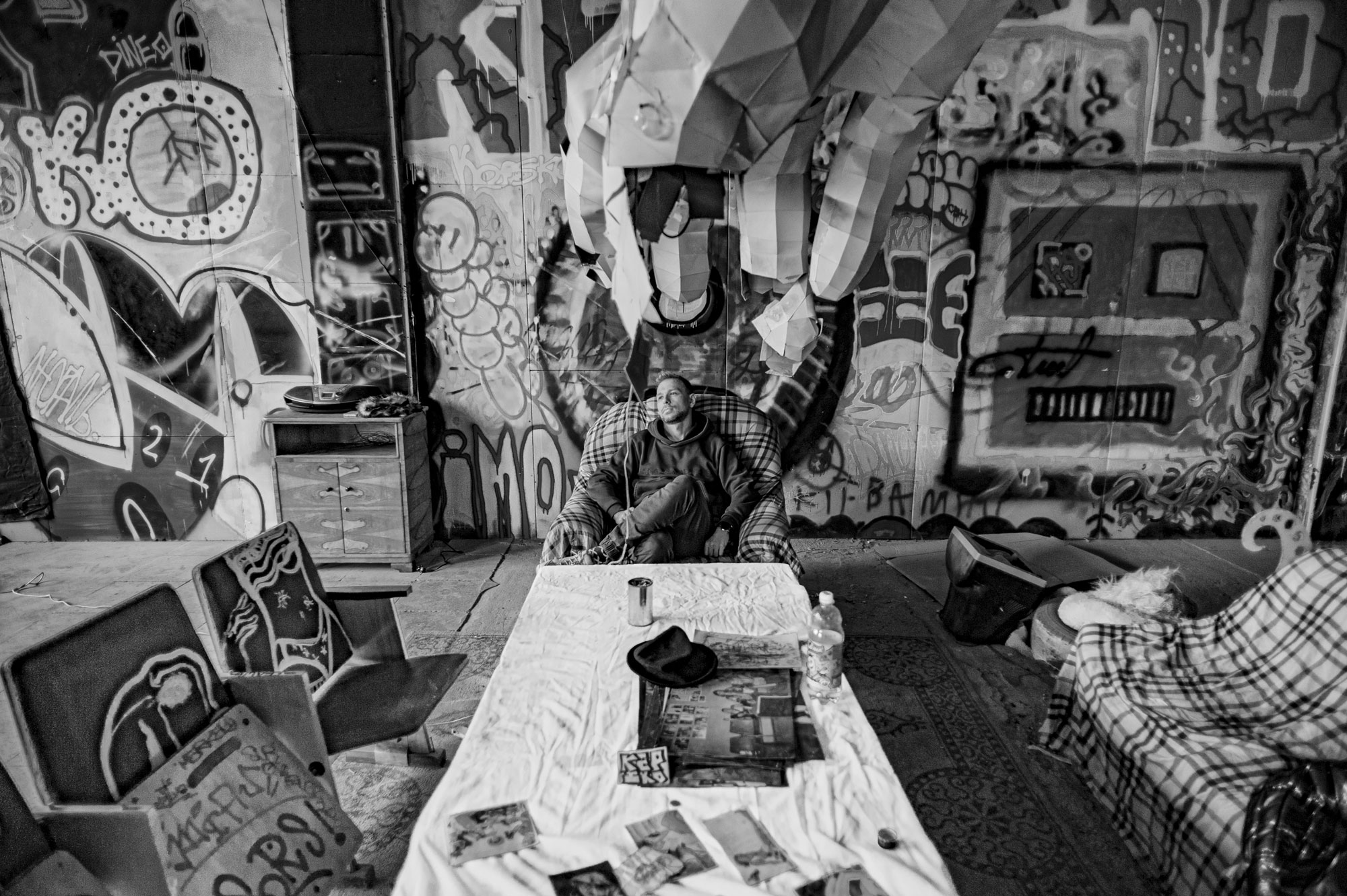
Oleksii Badin, fot. Stanislav Tolkachov
This film is interesting as artistic material for analysis and reflection. Many parallels can be drawn with our present time. You look at people and propaganda methods from a hundred years ago and realize that nothing has changed. So we created music for the film, and then, based on the fragments and sketches that remained, we developed them into full-fledged, independent compositions.
The album The Playground literally refers to a place for play or a children’s playground. The title alludes to more than two million Ukrainian children who, as a result of Russian aggression, have been deprived of parental care and forced to grow up prematurely, losing their life foundations. The album annotation read
All children are born equal, pure, and kind, but the game that begins on the playground assigns different roles. Some are given the role of the villain who takes millions of lives, others the role of the fighter against evil. Playing these roles, children so often carry them into real life. Everything begins on the playground.
Each of the album’s six tracks corresponds to a line from an absurdist children’s counting rhyme invented by Oleksii:
One danced in a dream that never ends
Two made a universe of sand
Three taught the bubblegum to wile
Four fell in love with the pigeon’s smile
Five had a pet rock that sang and cried
Six ate the avalanches in the rye
Western critics have described the album as “a small gem that gladly dissolves boundaries, turning upside down the roles traditionally assigned to instruments far older than the music played by these five Ukrainians. The bassoon becomes an electric bass, the oboe merges with synthesized sounds, and the sixth member of the band is Ableton Live software — a fully fledged, sometimes even dominant participant, yet one that never overshadows its human colleagues. With The Playground, DZ’OB offers innovative, danceable music that deliberately cultivates its own peculiar oddity — music full of warm colors and life, a genuine challenge within the field of electroacoustics” (Citizen Jazz).
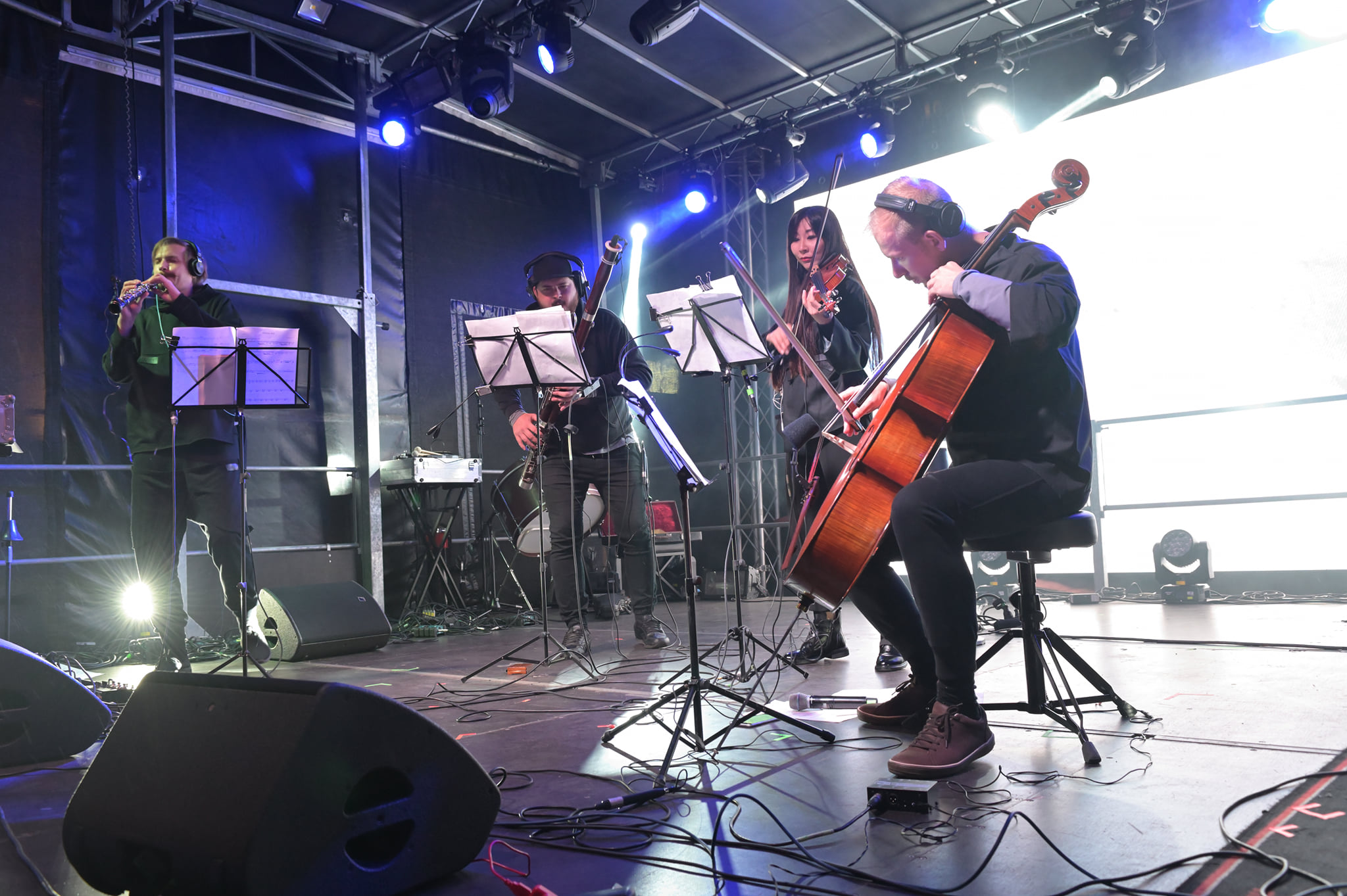
DZ’OB ensemble
One danced in a dream that never ends — The opening composition reveals an infinite imaginative space in which classical form transforms into an elusive dialogic labyrinth generated by characteristic rhythmic interruptions. Through a neo-Baroque lens, harpsichord counterpoints sound with renewed drive. Repetitive motives suggest a fantastical invention in the spirit of Bach. Most striking, however, is the lush persistence of ostinato figures permeating the entire work, generating continuous kinetic energy, while tritone inflections and genuinely Romantic cadential gestures introduce an eclectic charm.
Two made a universe of sand — Here, electronics move to the foreground, creating a more dance-oriented, techno-inflected atmosphere. Instead of a traditional percussion section, synthetic impulses convincingly maintain rhythmic momentum, while “matte,” muted strings seem to glide across the electronic foundation. Intellectual rigor is preserved: short, modally simple motifs are bound together through rhythmic complexity and textural density. Each instrument fulfills a precise role — the oboe operates within a constrained tessitura, intensifying focus, while a quasi-song form maintains coherence without sacrificing the overall vibe.
Three taught the bubblegum to wile — A slow diatonic line overlays rapid rhythmic figures, creating textural tension — the defining musical face of the third track. Its appeal lies in the cool, gradual unfolding of polyphonic layers. Timbral density grows alongside rhythmic compression as durations shorten and the music spirals inward. The reference point is a kind of neo-Renaissance suite for the digital age: what would traditionally be associated with extended twentieth-century instrumental techniques is here entrusted to electronics, while the acoustic instruments remain a living, untouched, human voice. This is music of a state rather than an action — an immersion into an inward dance, where worlds blur and epochs pass simultaneously.
Four fell in love with the pigeon’s smile — One of the rare tracks that at times sounds like a prayer, built from small musical “sheaves”—tiny thematic patches that together form a colorful, intricate lacework of meanings and sensations. The ensemble appears as minstrels of a new age—wandering birds carrying echoes of medieval genres, reimagined through electroacoustic sensibility. Their sonoristic discoveries embody laughter and tears alike, merging tragicomedy, childlike naïveté, and anxious premonition. A storm seems imminent—smoke from fires or bombs—yet you stand facing it with music instead of a shield. And it is unclear whether what you hold are flowers or torches.
Five had a pet rock that sang and cried — The fifth composition offers a tangible allusion to Vivaldi, yet is perceived as a reflection on European civilization and its medieval immaturity. This piece forms the dramatic culmination of the album, which lasts 33 minutes in total. Positioned precisely at the golden ratio, the track begins with low, aggressive chords that disrupt rather than complement, while a lyrical high-register melody simultaneously elevates and sustains tension. Modal harmony and the use of polytonality enrich the palette, creating a sense of internal collision.
Six ate the avalanches in the rye — The final track’s optimistic, hopeful character emerges through questioning intonations that balance between major tonality and modality. This synthesis lends the music both drive and irony, as if mocking reality itself, rendering the sound simultaneously light and profound. This idea resonates with the album’s visual design: the cover features a tapestry by Ukrainian artist Maria Mudrak, depicting a boy bombarding a playground with a paper airplane.
Oleksii discovered the artist’s work by chance on Facebook, where she posted tapestries in a group for artists selling their work. He was struck by her visual language — its minimalism, imagery, and technique — which he felt perfectly matched DZ’OB’s new album. He even sketched the central image in pencil: a boy with a paper airplane, exactly as he imagined the album’s main symbol. The tapestry did not appear immediately; the process lasted almost a year, with pauses typical of artistic collaborations. It is now kept in Badin’s home, becoming a symbol of childhood innocence standing against the cruelty of the world.
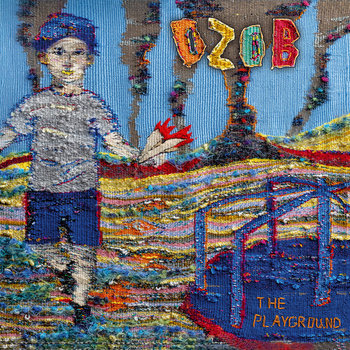
Okładka płyty The Playground
Identity and Creative Search
In medieval heraldry and works of art, musicians often appear alongside birds — nightingales, swans, cuckoos — symbols of freedom and inspiration. Perhaps it is no coincidence that the nightingale, beloved by poets and minstrels, is also one of Ukraine’s symbols. Since the outbreak of war, themes of loss and hope have taken root in the ensemble’s music, opening new spaces.
OB: “This album remained unpublished the longest. When we finally released it this year, I sighed with relief: it had finally happened, and I could let it go. We began creating music based on that soundtrack back in 2019, I think. Everything was finished and recorded before the full-scale invasion; afterward, we only worked on mastering. Thematically, the album is connected to my personal story. When the full-scale war began, my son and his family went to Poland. He was six years old. That separation affected me the most. I went through it very painfully. That’s why the image of a boy running across a playground with a paper airplane is composite—but first and foremost, it is mine.
Oleksii continues: We never had the goal of making music for someone specific. I once heard in a podcast that you need to know what you’re making music for—a techno party, an opera hall, and so on. We simply do what we want; it’s always about searching. Our instruments are academic, but we play techno. In reality, we exist between worlds. The academic scene often doesn’t accept us, and for techno we are sometimes too complex or too quiet.
The creative process is always a struggle for me. While working on the last album, Maksym and I initially worked separately. Maksym usually handled the electronic part, while I created instrumental parts and shaped the form. Often, when you have an acoustic foundation, adding electronics becomes difficult. I don’t know why. Even when I came to Maksym with ideas, he sometimes couldn’t immediately find the right sound. For example, in “A Girl with a Kitten in the Moonlight,” which has a very active electronic part, Maksym reworked it from scratch three or four times. I revise acoustic material even more—there’s an episode in “T-Rex Song” that I kept changing for two months.
Our approach is not to imitate electronics with acoustics, but to take electronic means of expression and recreate them acoustically. Sometimes a synthesizer sketch becomes the basis for acoustic instruments. Academic thinking is different, it’s almost the opposite domain, with its own rules: sequencers, arpeggiators, effects, detune, delay, tape delay, play delay. Through this interaction, you create something new, and when you then try to reproduce it acoustically, a third version emerges. That’s what interests us — the research.
DZ’OB has no fixed musical language. If you hear Bach, you immediately know it’s Bach. With us, it’s constant searching. That’s why the process is so difficult, you make countless attempts to reach what you want.
People almost never dance to our music. We often joke at concerts that at first it was also unclear how to dance to The Rite of Spring, but eventually it worked out. The only ones who always dance at our concerts are children.
It also depends on the venue. At Jazztage Görlitz, the organizers wanted something exclusive, not jazz, but with a dance component. They invited us and a German group combining trombone, trumpet, cello, and electronics. Their sound was closer to straight techno, so everyone danced to them. To our music— people tried, but it didn’t quite work. Though we do encourage it.”