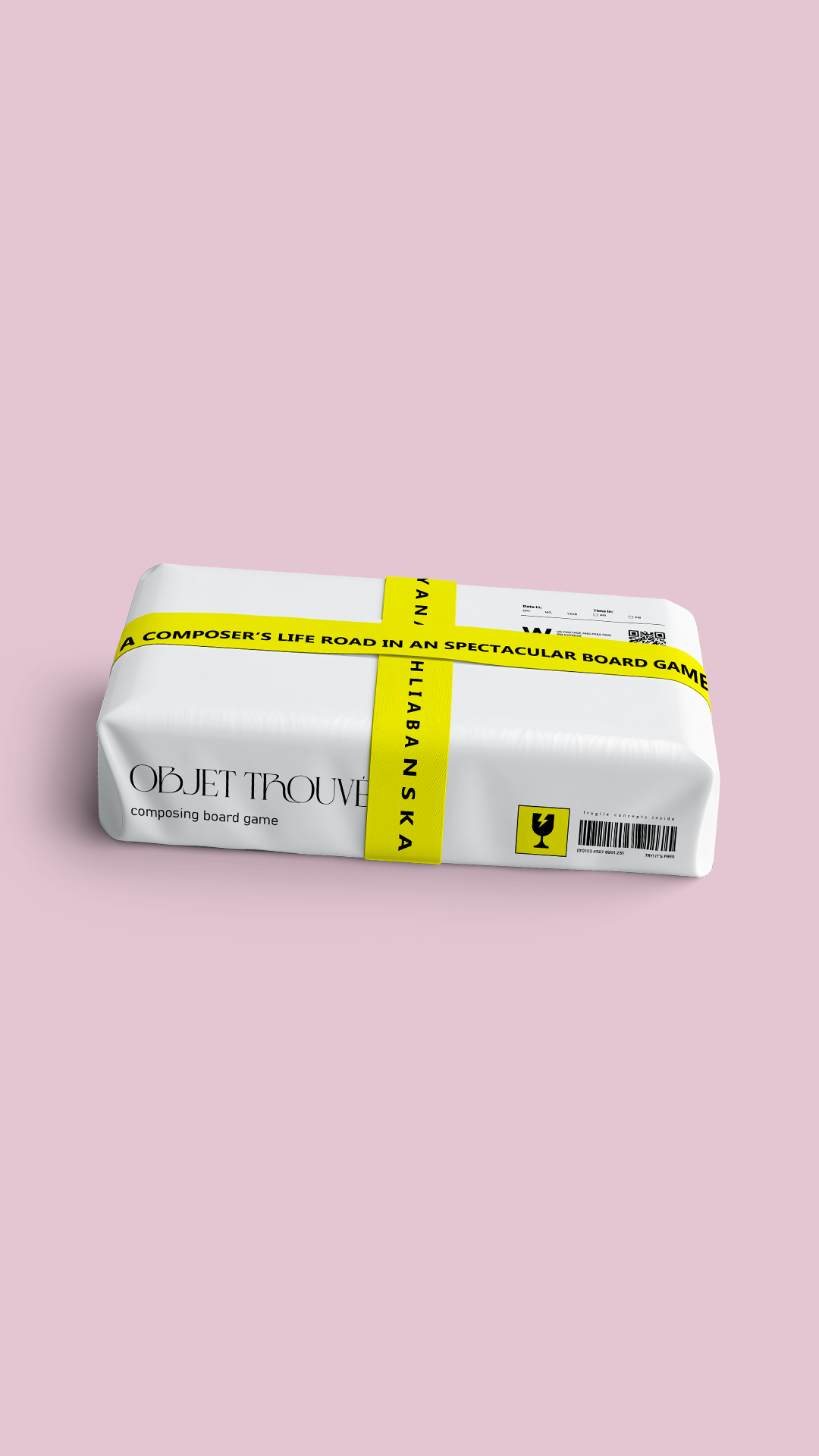
composing board game
Yana Shliabanska: Music not only for listening
We meet on a call at the end of October. Yana Shliabanska calls me from a phone, sitting outside – evenings have already started to get chilly, but I guess she used this as a break from composing work. She’s currently writing an opera. Despite my curiosity, Yana doesn’t like to reveal anything about it – it’s still a lot of time until the premiere on May 15th 2026 in Dessau, Germany. The heroine of the opera tries to find out what happened to her great-grandfather who has disappeared without a trace in the 1930s. The only person who might still retain fragments of memories about him is gradually slipping into dementia. Despite this, she attempts to reconstruct her family’s chain of memory. Her search eventually leads her to Sandarmokh — a mass burial site of the victims of the so-called “Stalinist purges.” The events unfold through a series of phantasmagorical shifts in time and space. Instead of delving into the futre plans, we decide to start the conversation around the most recent Quartet (2025) for solo saxophonists, written during the IRCAM Cursus program. Shliabanska has already had a chance to work there as a part of Manifest Academy in 2022. I ask Yana to compare these experiences, but…
Yana Shliabanska: There’s nothing to compare. One was like a short touch with IRCAM, the other offered a full program that let me really dive into IRCAM as an institution, for one year’s course. You literally spend days and even nights there! My curator was Pierre Jodlowski, in my opinion he’s especially good at working with young composers. He inspired me a lot, helped me develop the best of my ideas. It has been an intensive year and I’m kind of still reflecting on this time. Especially on the premiere of Quartet, soon to be available on the internet.
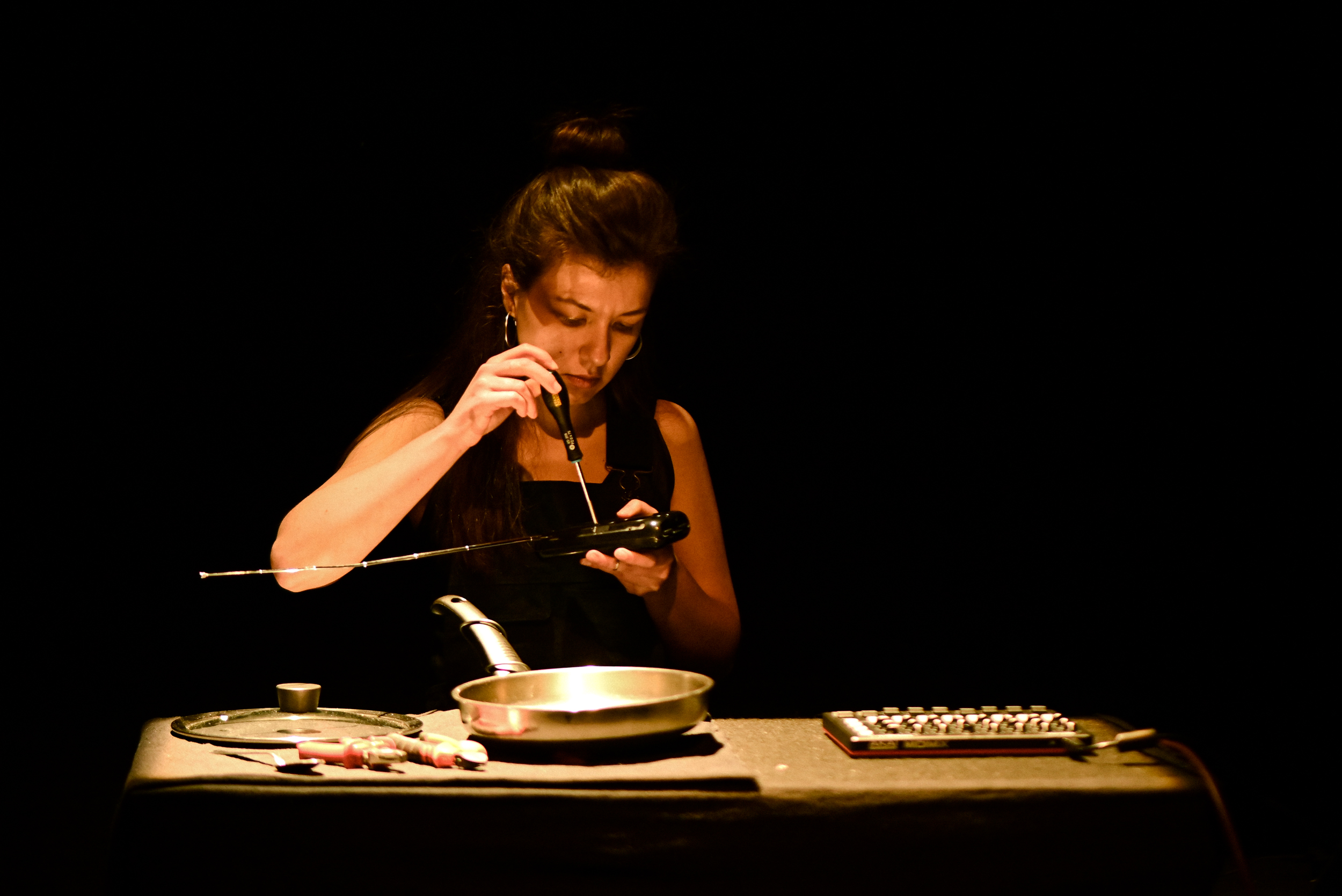
Yana Shliabanska, Pan Serenade (2023), fot. Ksenia Yanko
Marta Konieczna: I loved this piece. Notably – the use of space, where the performer runs from one saxophone to the other, pacing up to create a quartet as a soloist.
YS: I have been searching for some kind of specific language to talk about what is happening in my country right now and what is my own experience of it. Working on the idea of this piece, I questioned myself: What can I say now? What do I feel now? And the answer is absolutely clear for me – it’s emptiness. Also the absence of the people, the lack of them. Especially the ones from my generation who are literally, physically taken from society and the communities. They suddenly just don’t exist. This is a big tragedy, as we would be responsible for rebuilding the country. And they are the best! Going first being so brave, having strong ideas and then just falling first.
And that’s how the idea of showing the lack of people came to me. Of showing how it feels. To make it more clear, I decided to work with the distance – placing these four instruments not secluded as I eventually did, but in a row for example, wouldn’t be as dramatic. The far distance lets us experience how hard it is for the performer to keep up pace and how on edge they are. They need to constantly cross the audience, like a school of fish, that regathers around tightly each time they switch positions. That was another important aspect of the composition for me – how do we work and interact with the audience. I have had this question on my mind since 2018. That’s the year when we created the sound installation Verbova (2018), consisting of wooden desks or rather walking on them. This act was my reflection on the communication with the audience, how to listen to the music. Thus I decided to make something interactive. The listener isn’t static, their movements, their body is involved in the listening process. This very idea persists in the Quartet. Moreover, the audience should be standing all the time, be attentive to the movements of the performer, constantly turn and move themselves. This allows seeing the musician from different spots and perspectives, too. However in the end – it’t the spectator’s responsibility and freedom – to change this position and perspective at any moment.
MK: The lack of people, yet the room is full… Since you also speak about the need to activate people into changing their perspectives, it makes me wonder about the musical community in general, European notably. What should this community do in terms of aggression in Ukraine? How to support Ukrainian artists now? What do you expect from the musical community to do?
YS: I don’t know if right now I can relate myself to this piece. Recently, I’m feeling a bit isolated. Despite the number of platforms for Ukrainian artists, it was really nice — probably the first time in history that we were so much in focus, that there was such attention to what we’re doing. Because earlier we didn’t exist on the European musical map in general. It was very good that we got the ability to say something. However now I think that it doesn’t work in this form anymore. But I’m not the person to propose any solutions… Maybe it would be more meaningful not only to give a place for Ukrainian artists, but also to establish long-term collaborations. My dream is not to be an artist in an extra position because I’m Ukrainian, but because my work is good. As it was with IRCAM, for example – being chosen as an artist, not as a Ukrainian artist.
MK: And isn’t it that in general the artists from Eastern and Central Europe are often not seen in the broader scene? Do you feel that the perception of your works is different in the Western societies?
YS: It depends on the place. For example, in Paris, I’ve felt a huge diversity both in culture and everyday life, I wasn’t feeling like a foreigner. In Poland, I would say it’s still more conservative.
MK: If it is okay to ask, how has the outbreak of war changed your way of composing?
YS: There is not much that I want to say about this. Of course it has influenced my work because it has influenced my personality. First of all, it influenced me as a human, what I feel and what I’m worried about.
MK: There is a short video of you on YouTube presenting your sound for the exhibition of Daria Koltsova.
YS: It’s good that this video exists. It was a part of a project at the beginning of war. Kyiv Contemporary Music Days’ organizers asked us the Ukrainian composers to make a short video from where we were at the moment. For me it’s a kind of a documentation of that period of the beginning of war. It’s something very tiny, but serves as a picture of that time and state.
MK: But let’s talk about your music. Last year you performed at the Warsaw Autumn Festival. Ten Commandments – not a typical composition, but a multimedia performance. It used Polish posters, so what is the idea behind it?
YS: I’ve just seen the video of it yesterday, so, my feelings are kind of fresh. I wanted to work with Polish posters, having seen them at the Biennale of Posters here in Warsaw. I already knew about the huge history of Polish poster school and was eager to get to know more. Thanks to some friends from Warsaw’s Academy of Fine Arts I was able to browse its library. The topic of Occupational safety and health clicked. I realized it could be funny to use those old school posters and treat them as metaphors, as the ten ironic commandments.
The starting point was a poster with a big iron, a very funny poster. I started to build an instrument with my colleague – Ereh Saw – a media artist from Ukraine. He turned this everyday object into a noise instrument. And I’m a big fan of noise. Another performance of mine, Pan Serenade (2023) also used a similar concept – in that case a pan. A pan… an iron… And I will continue using other objects in the future too, I already have some ideas.
Ten Commandments is about freedom, through irony. I really wanted to make something on the edge, not really clear whether it’s serious or not. It’s really interesting for me to play on this edge. We play football with the head of Kim Jong-il in 1950s costumes, whilst continuing to play the piece — or rather, trying to keep playing. And it sounds terrible. This music is not only for listening. It’s also for watching.
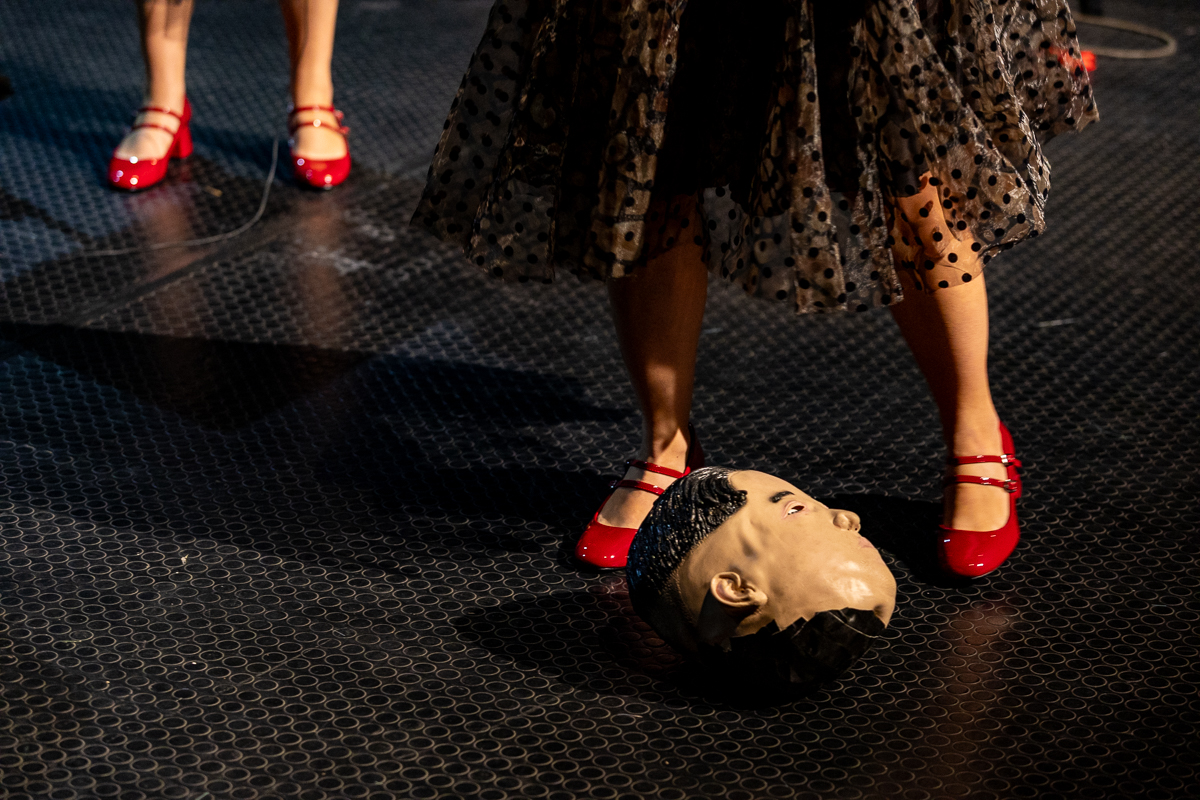
Yana Shliabanska, Ten Commandments, Warsaw Autumn 2024, fot. Rafał Latoszek
MK: This one piece contains… I’d say three very visible lines in your music. First is the use of everyday objects that turn them into instruments. The second is the electricity and the cables (also in Pan serenade) but also the specific sounds of electronic objects. And the buzzing noise. I feel like I’ve heard this buzzing in many of your pieces. And, of course, the performative aspect. Are you rather working with electronics or electricity?
YS: I really like the aesthetic of electronics, especially the radio ones. All that analog stuff. In 2019 I got a grant for a very big project for an interactive sound installation Breathing for 100 loudspeakers. And we started to work on this project. Although we had not enough money and resources to do it, we were ambitious and a bit naive.
Behind this installation itself there was a wall kilometers of cables. It was really impressing visualy and inspired me a lot. We were cutting and soldering them day and night. Cutting the cable into pieces, as well as breaking the radio by hand and then “frying” it in a pan in Pan Serenade, was, in essence, a brutal ironic gesture. In fact, this is my suggestion for how to deal with the hateful and endless information that devours you.
I think it’s very poetic to work with semi-exposed cables; they are like a vulnerable, naked nerve. In Ten Commandments I wanted to grab in hand a broken audio cable connected to the sound system on stage. But as it wasn’t really safe, I decided, okay to work only with a jack plug. It’s like touching something forbidden, the electronics not like it shouldn’t be touched. And this is strongly related to my personality – when I started to play electronics, I started on the noise scene, in the underground. It was a way of protesting the Academy of Music and its community. My friend and I created a duo around 2017. Its name was GUMA . We were two girls, both trained as classical musicians, looking like ‘’good girls’’, coming to these noisy parties with old men playing loud noise. And we played with their noise too. It meant freedom for me a lot, how to grasp or bring some fresh air in this music. A very refreshing time after the period of our musical education, starting at age six: with a lot of rules, conservative perspectives, being told what is good, what is wrong, what is forbidden. How to create a waltz? How to create a polka? What is music? Back then we didn’t even question ourselves.
Coming back to cables however, we started to play electronics without any idea of how to play electronics. Now I think this lack of approach was kind of the approach itself. We had one laptop for the two of us! And a graphic tablet that we’ve decided to use this way. But we had to invent the way. I would like to preserve this kind of attitude in my professional life. This wonder of the sound. Even though now I kind of know what to do – well, I’ve spent a year in IRCAM whatsoever (laughs).
MK: Are you trying to evoke something from these everyday objects? Are they the objects sonores to your music, or rather the instruments?
YS: I rather not consider them as sound objects or sounding objects, but as instruments indeed. Pans, irons, glasses and I already have another one on my mind – although again I cannot tell much more about it…
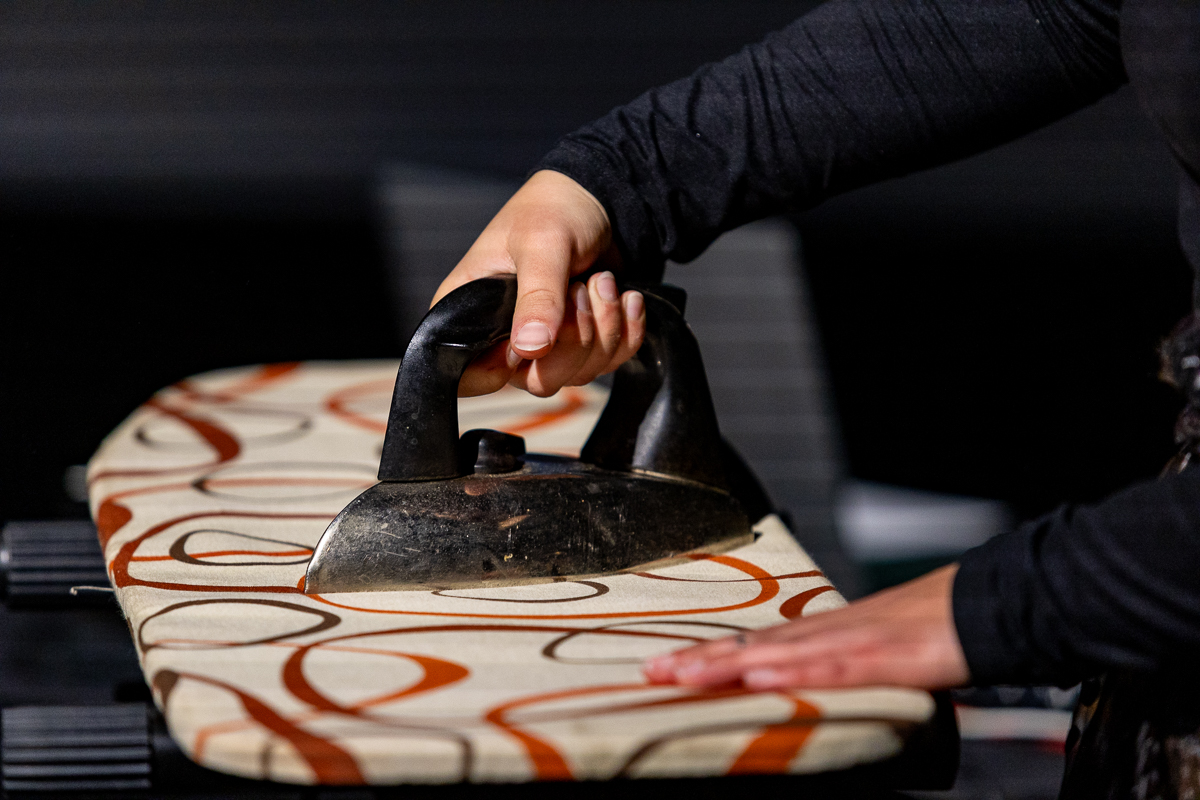
Yana Shliabanska, Ten Commandments, Warsaw Autumn 2024, fot. Rafał Latoszek
MK: And you have written an article on meta-instruments in the works of Chaya Chernowin?
YS: That’s correct I was preparing a thesis on her work, but haven’t finished it. However our composing approaches to this matter are very different. That’s even the reason, I think, why I’ve stopped this research – I felt that I cannot connect myself to her.
MK: And there are also some instruments of unidentified objects… Yana, please tell me, what are you playing on in the MOTION[LESS] (2020) piece?
YS: Oh it’s a funny story, it may look like an instrument, but it really is a found object. I came to the Gallery, about to perform the piece in five minutes, and then I saw it. It kind of resembled a mill – the main object on the video that assists the composition. They’ve told me it was from a piece of art, left by its author to be thrown away. ‘’Yes, yes, we threw it away, just take it!’’ They told me and I’ve figured out how to play it musically. All it took was some alligator clips and Arduino. So yes, I guess you can say I’m stealing things (laughs).
MK: And I thought it was some unique Playtronica Synth… Okay, so speaking of performances, you are a performer in lots of your own works. But not all of them. You are familiar with staying in the role of a composer. What is this peculiar distinction for you like? How do you switch between the roles?
YS: I don’t see that much difference, actually. I just love to play, whenever I can take this opportunity. I love being on the stage too, and sometimes when I cannot do it, I actually perform on the backstage, for example electronics, or sound design of a theatre performance. Also, it’s like a part of a game – and I love games as well. Performing helps me to understand and connect with the performer. What can I tell them if I’d never experienced this by myself, right?
I hear a lot of composers deciding to perform their music themselves because they want to control it. They say: no one will play it better than me. But that’s not the point for me. That’s why my scores often offer some kind of freedom for interpretation. However I’m not thinking of improvisation, the scores are quite determined. I rather spare space for the performer’s input. The common work on a piece, it’s about communication, not about directiveness.
MK However the beautiful graphic score for Mill: the conversion of energy (2017) looks like an example of less directiveness and much space for the said input, right?
YS: Not so much. It’s very algorithmic! You need to read it really precisely, although I agree it looks like it could be an open graphic score. But that’s just my specific way of writing.
For me, music nowadays consists not only of sound, but also of performative, visual, and movement layers.
In Mill, there is this visual aspect included, however it’s not just a visualization of the piece. It’s a part of the expression of this specific piece. Indeed I was trying to draw the wings of a windmill in that score – they are in the circle and they are moving, right? Moreover, the performers are sitting in a circle during the performance, and the sound acoustically moves around this circle.
fot. Roman Chyhrynets
MK: On the other hand, your scores seem rather detailed. wouldn’t say strict, because there are some fun jokes, like a little meme-like skeleton with a sax in Quartet. In other parts of it though – sketches indicating how to hold a saxophone. Do you have any specific aspects of doing so? Because the scores seem to really communicate with the musician.
YS: Thinking of it now, I was trying to avoid linear narratives in writing music, it doesn’t match with it for me. In my perception of sound, some events happen rather simultaneously, even though they occur one after another, and I’d like not only to think about it this way, but to see it all at once. Same happens in the score for Con fuoco (2023), a scheme of a game, a one that cannot read it from the beginning to the end. The piece doesn’t actually have a full ensemble score, only composed parts of it. Even more – The Route of [Im]probabilities (2024). However it can be a challenge in communication with a performer sometimes.
MK: And a mill has also appeared in the MOTION[LESS] performance that we’ve discussed earlier. What is it about them?
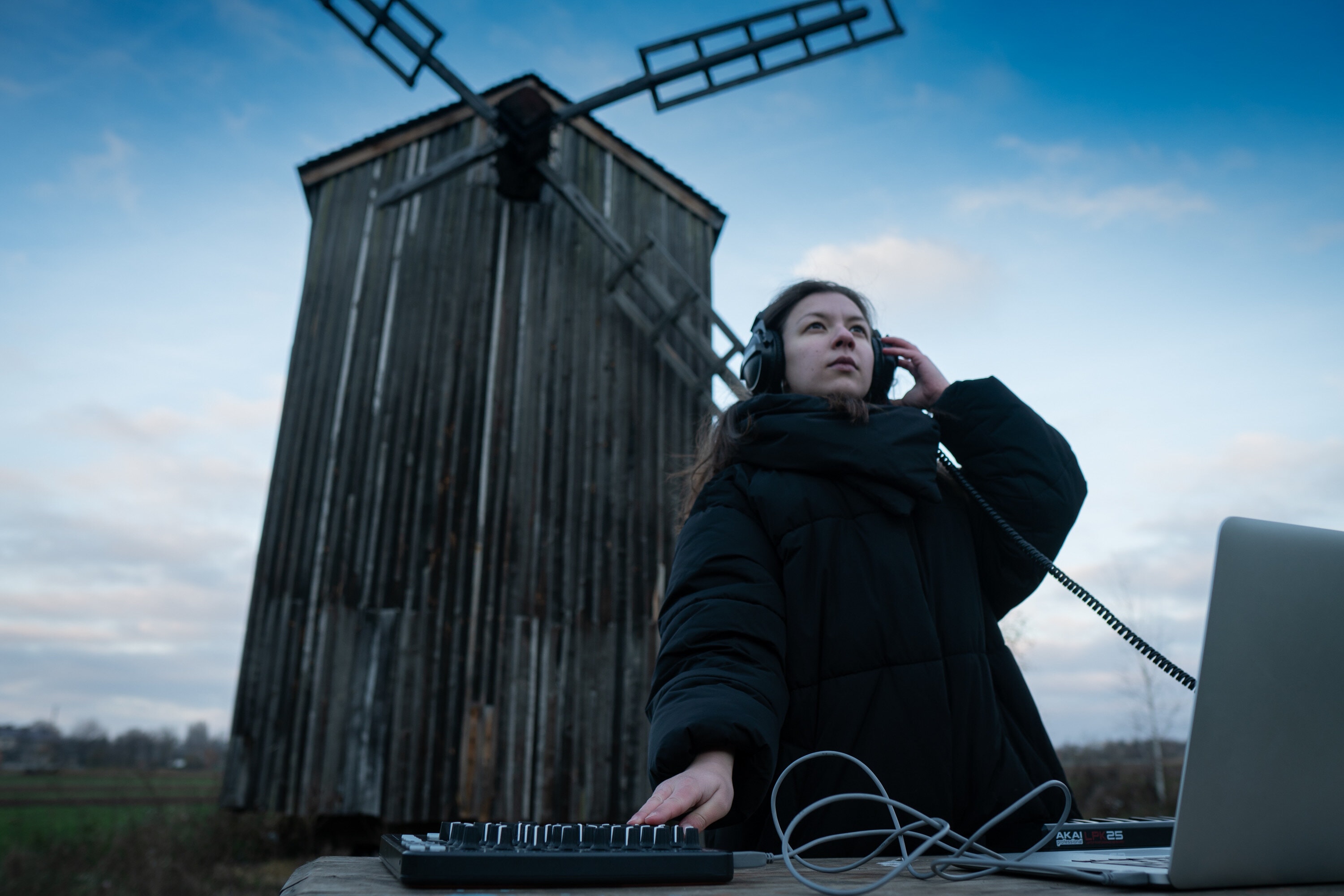
YS: There’s something magical in this object for me, that’s true. They’re very old, very ancient, they contain the potential for perpetual motion of rotation, even when at rest… In the case of that performance I’ve decided to go to the very old windmill in the Poltava region of Ukraine. It is called Dykanka. The windmill isn’t working anymore, so in the video а circular motion was added to evoke the movement of it. I love that my work makes me go on adventures – like this one.
It was in the field, in the middle of nowhere, it was cold, at the end of autumn. The wind was blowing everywhere, no people around. In the end I was playing electronics only for this mill, actually. Just to make it move.
MK: Now I understand where this sense of eeriness comes from in that piece. It’s a kind of atmosphere that you like to play with – another, even much stronger example, would be OUT[come] (2021), musicians covered in safety clothing and masks playing instruments while slowly wandering through the gallery space.
YS: This piece is about Chernobyl — to be precise, the story of the three divers who went into the radioactive water right after the explosion to close the valves and prevent another explosion.
The three musicians draw an analogy with them. When I saw the location, it turned out there was a huge well-like structure. The audience is above, and the musicians really do dive underneath. But only afterward did the connection to the COVID pandemic click for me.
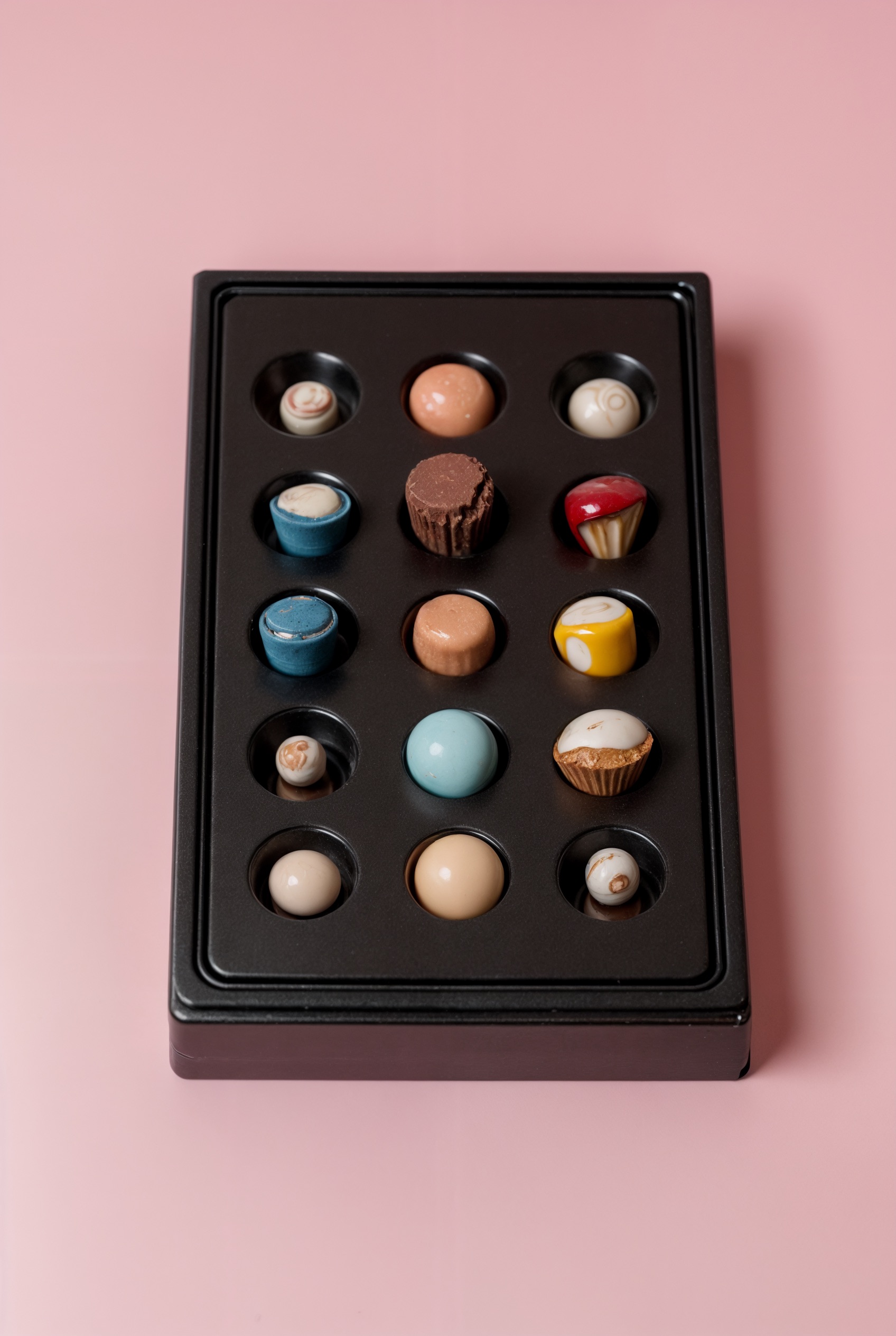
MK: The Route of [Im]probabilities has a score in the form of a board game. It is also dedicated for an ensemble and – what is really interesting – non-musical children.
YS: It’s a specific project, dedicated for temporarily displaced families. I imagined it as a kind of therapeutic game. I wanted to create a space for kids where they can act, treat themselves, and communicate with musicians. And I love the results of the project! For us, classically trained musicians, it’s already impossible to perceive music in such a clean way. We have a lot of cliches in our mind. It was such a pleasure to observe how these kids listen to the sound. What are they paying attention to? How are they working musically with different objects? And it was really interesting to see my experience of musical education through them.
MK: What is it about your musical education?
YS: It’s a very long, long way. I didn’t do anything else besides music in my life professionally. I wanted to compose from a young age. I wrote in my diary that I wanted to be a composer at the age of 10. Although I didn’t actually know how to do it and didn’t have a teacher. But when I found one it instantly became really serious for me. I was gathering information from everything. The diary then became a space where I worked on different forms and exercises I wrote for myself. Everything I thought would be useful for me as a composer. I was really passionate about educating myself, not just being educated in school.
MK: Okay, I won’t let you sit outside for too long! Thank you Yana for your time and I wish you a good time working on your next piece!
YS: Thank you too Marta!